"Serving Size 1 sleeve of cookiesThat's how I always eat them, anyway.
Servings per Box 2."
Wednesday, January 31, 2018
Complaint department
Girl Scout cookies are incorrectly labeled. They should say:

Tuesday, January 23, 2018
Ah, the good old days when the worst thing you could be stuck on a long flight with was a crying baby....
I just keep finding more and more reasons to be thankful that I've only flown once since 9/11. I can't imagine paying the price of an airline ticket for the descent into the seventh circle of hell it sounds like air travel has become.
*checks actuarial tables for parakeets* Ms. MacDonald, I have some bad news for you.
This woman's psychologist should produce a letter from her psychologist for endorsing this ridiculousness. Thirty years ago, the very concept of being unable to spend several hours away from a pet bird would be cause to send someone to a mental health professional.
Ashley Marie MacDonald, 29, says she doesn't mind producing a letter from her psychologist when she flies with her emotional-support parakeet, who stays in his cage. She has had anxiety, depression, and a pain disorder since a work-related injury in 2012, and says she doesn't want to be away from Stormy or "think about life without him."
*checks actuarial tables for parakeets* Ms. MacDonald, I have some bad news for you.
This woman's psychologist should produce a letter from her psychologist for endorsing this ridiculousness. Thirty years ago, the very concept of being unable to spend several hours away from a pet bird would be cause to send someone to a mental health professional.
Monday, January 22, 2018
Fun Facts To Know And Tell
Did you know that Billy Ray Cyrus's signature song owes a great deal to Fats Domino? Because I sure didn't.
Sunday, January 21, 2018
Biblioutrage
The competition was tight for which article in the Sunday paper I found most distasteful. There was this gem about public high schools removing thousands of books from their libraries. Not for censorship reasons, which is still highly denouncible, but to make the rooms more spacious and airy so students can make crafts and play games, eat lunch and drink coffee there.
"It's really spacious now," Farley [a 17-year-old student] said. "Before it was really crowded with all the shelves."
Much more spacious, my dear Farley, I dare say, but it would not be near so much like a library.
Amazingly, though, that story lost out to the grousings of the underappreciated Caleb Carr, author of The Alienist. His book was a bestseller in 1994, but that means nothing to Carr: only having his book put on screen matters.
"It seemed like a really futile struggle to continue the series when there was no interest in making a decent product out of the first book, much less the second book, much less a future book," Carr said.
Apparently, it's an utter waste of time to create a book if it is to be enjoyed only by readers. *Sideshow Bob shudder* Only turning one's creativity into a media franchise is a worthy goal. One wonders why Dickens and Austen ever persisted, given the complete futility of their work.
Friday, January 19, 2018
Book review: I Am a Church Member by Thom S. Rainer

I find the vast majority of these little hardbacklets rather shallow (the one notable exception is How to Respond When You Feel Mistreated by John Bevere), and I will admit that I am not the target audience for what is blatantly pitched at an introductory level. The most interesting part of this book was the "Tale of Two Church Members" in the introduction, an imagined dialogue between Goofus and Gallant which illustrates the divide between the consumer and commitment mentalities and which is unfortunately dropped entirely once the book proper begins. I would have liked to have seen "Michael" respond to "Liam" in character and perhaps effect some change in his mindset rather than Rainer's more straightforward six-point sermon.
Rainer is undoubtedly correct that the consumer mentality is a major force behind church-shopping in modern American culture: finding a church that meets my felt needs; makes few, if any, demands; offers the ministries and programs that interest me and my family without asking me to participate in providing them; meets at a time and location convenient to me; etc. I am not, however, convinced that it contributes to Millennials rejecting Christianity in toto.
There is much lamenting over the lower church-membership rolls now than in the 1950s, but I steadfastly refuse to get worked up over it. The truth is that in the mid-twentieth century, church membership was a status symbol, a shorthand certification that one was decent and respectable. (Several years ago, a member of the much-lauded Builder generation walked through the room while a scene from "Left Behind" (I know, I know) played on the TV screen. When he asked what was on, I explained that it was a Christian movie. "That doesn't look very Christian to me," he remarked primly with a pointed look. It took me some time to realize that he made that determination based on the fact that a character on the screen had a gun in his hand. "Christian," in his mind, meant inoffensive and suitable for children. I can only imagine if he walked into a screening of "The Passion of the Christ.") Today, due to shifts in the moral culture, a similar level of virtue-signalling is achieved by serving on the board of a secular charity. Jesus made it clear that it would only ever be a minority that would follow him. In my opinion, church rolls in past generations were wildly inflated and are now perhaps returning to a more honest level, when the worldly benefits of membership are lessened.
Wednesday, January 17, 2018
"Popular Teen Injured in Car Accident; Less Popular Teens Also Involved"
Obligatory disclaimer that this is a very sad story, I can't imagine how terrible the family must feel, my heart goes out to them, etc.
Clicked on a story in a news aggregator about a ten-year-old boy dying from the flu. The lede? "A popular New Canaan 10-year-old is the first child in Connecticut to die of flu-related illness this season."
Whoa. "Popular?" What does his popularity have to do with the story? Are we more devastated because he was popular than if he had been less so? Are we to judge the extent of the tragedy by how many other children liked him? If so, would the death of a less popular child be easier to take? Would the journalist describe that child as lonely, friendless, or socially awkward in the first sentence?
It's like one of those awful glossy puff pieces on Important People which feel the need to describe what the interviewees are wearing, or the ice-blueness of their eyes, or the delicacy and/or strength of their hands as they gesture, and the reader is left wondering what on earth their physical appearance has to do with their success as a business tycoon or director or politician. It's like they're trying to combine Human Interest with Hard News and doing it very badly.
Tuesday, January 9, 2018
Book review: Jesus' Terrible Financial Advice by John Thornton
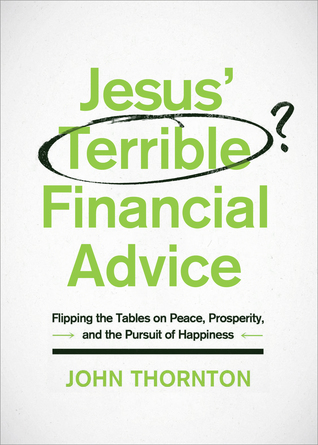
Beginning with the Sermon on the Mount, Thornton points out the various ways that we elide or explain away some of Jesus's most radical statements because, well, surely he couldn't actually mean that.
"And if anyone wants to sue you and take your shirt, hand over your coat as well" (Matt. 5:40).
Huh? In case you missed it, let me tell you straight up that this is terrible financial advice. And on so many levels! Obviously Jesus didn't grow up in America. We love to sue people! It's our national pastime.
.....
And His follow-up was even worse.
"Give to the one who asks you" (Matt. 5:42).
Did He mean everybody? I'd be broke in a week! Why not buy my wife the shirt "I'm with Stupid!," add a big tat to my forehead that confirms it, and stand on the street corner with a stack of $50s until the carnage is complete?
However, based on his bedrock rule that "If my theology disagrees with God, one of us is wrong, and it's not Him," Thornton explores what it means if Jesus really did mean exactly what he said.
The author reaches the conclusion that the reason one cannot love both God and money is that money, when it is "loved," is an idol, something that makes the same promises God does to protect and provide for us. Just as the Israelites performed rites both at the temple and at the high places, to "cover their bets" in case one or the other god didn't respond, we may see money as something that can give us what God declines to. Money is only seen rightly when it is seen as a lesser blessing than the utmost God has for us in his will.
Starting from the position that Jesus really means what he says, Thornton draws out principles and implications from Jesus's teaching about money, parables about wealth and possessions, and interactions with people rich, poor, and in between. This is an invaluable little book that will broaden the reader's perspective on the Christian approach to giving, saving, retirement, and everything else dealing with money.
Subscribe to:
Posts (Atom)
