So this is McDonald's' Super Bowl commercial:
Faith watched this ad unfold with a look of growing horror on her face. When it was over, she turned to me and said, "Let's not go to McDonald's until that's over." She can't imagine anything more embarrassing than being part of a public display of affection with her family when all she wants is a chicken sandwich.
Probably not the reaction McDonald's was going for. ;)
Monday, February 2, 2015

Friday, January 30, 2015
Book review: Mr. Kiss and Tell by Rob Thomas and Jennifer Graham
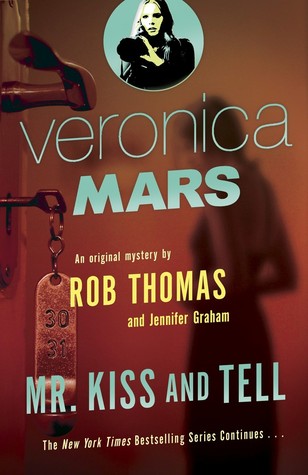
Rob Thomas is the creator of the show so, unlike some novelizations, all the dialogue is utterly true to the characters; you can just hear the actors from the series delivering the lines. I think it's utterly ridiculous, however, for the authors to expect the reader to believe that Veronica Mars can visit the parent of a former classmate using a false name and not be recognized. Frankly, by this time, anyone in Neptune ought to recognize the daughter of their former sheriff considering all the times she ought to have been featured in local newscasts and newspapers for her crime-solving and involvement in various scandals.
More unfortunately, this book revisits one of the most egregious of the TV series's missteps in the Manning family, which is simultaneously wealthy and powerful and fundamentalist Christian in a beach town in southern California. They're prominent in their church ... which no one else in town attends ... and they're part of the Quiverfull movement ... despite having only three children. Nothing about them makes the slightest bit of sense, but you can feel the self-righteous vindictiveness flow out of Thomas' and Graham's pens. Biker gangs? Mostly nice guys who are misunderstood, and their petty crimes are small potatoes compared to the systemic violence and corruption of society. Prostitutes? Brave and kind women who have taken control of their own bodies to achieve their dreams and deserve respect for their choices. Evangelical Christians? 100% evil, beyond the pale, with no redeeming qualities whatsoever.
The Mannings' religious leanings aren't even relevant to the plot; it's just an excuse to bash Christians. Ironically, one of the main political points raised by the story is the victimization of prostitutes, who are often assaulted or otherwise abused but are afraid to go to the police lest they be arrested because of their jobs. You know who have been main players in efforts to stop sex trafficking and to prosecute pimps and johns instead of prostitutes? Christian ministries.
After the Veronica Mars movie, only two novels were announced. I don't know if there will be any further books in the series (although this book certainly sets up some intriguing changes in Neptune that I'd like to hear more about), but I'll certainly buy a third if it's published.
Thursday, January 29, 2015
Marcia! Marcia! Marcia!
Monday, January 26, 2015
Book review: Blue Shoes and Happiness by Alexander McCall Smith

It is in the nature of the series that Blue Shoes and Happiness doesn't introduce any new and revolutionary twists into the formula. No new characters are introduced, although the latest addition to the combination garage/detective agency at the heart of the story, Mr. Polopetsi, makes a sad mistake as he tries to contribute to the latter side of the business. Charlie, the older apprentice, might actually be getting serious about a girl ... but if he does, it's not confirmed in this installment. The younger and less troublesome apprentice still hasn't been given the dignity of a name. On the continuity front, Grace Makutsi is still making two kinds of tea, which is good, although we are suddenly confronted with the never-before-hinted-at assertion that she was widowed at some point in her backstory, which is bad.
The blue shoes of the title are Mma Makutsi's. (The shoes pictured on the cover are most emphatically not her shoes, which explicitly have a red lining in the story.) Mma Makutsi continues her evolution as a terrific character, with the hilarious and charming trait of imagining her shoes berating her for her missteps as she looks at the ground in anxiety or consternation: "You've done it, Boss, said the shoes. Don't expect us to carry you all around town looking for another man. You had one and now you don't. Bad luck, Boss. Bad luck."
As for Mma Ramotswe, she has a characteristically conservative outlook on societal change and the younger generation: "Take one country, with all that the country means, with its kind people, and their smiles, and their habit of helping one another; ignore all this; shake about; add modern ideas; bake until ruined."
Friday, January 23, 2015
Book review: Sidney Chambers and the Shadow of Death by James Runcie

As it turns out, I chose not to watch the series at this time. I read a review of the first episode that made it appear the romance angle was really played up for TV, a romance that only makes a tentative and half-hearted appearance halfway through the book. I can't stand sexed-up adaptations, and frankly the book itself, with its back-cover blurb about Sidney having "eyes the color of hazelnuts" already makes me think of Rose from "Keeping Up Appearances" cooing over the "dishy vicar."
This sixth book I read in 2015 is the first of a planned six volumes of The Grantchester Mysteries. Without huge reserves of enthusiasm, I'll probably sign on for the complete trip. Sidney Chambers is the vicar of Grantchester in Cambridge in the early 1950s: 1953-54, in fact, in this volume, which gives precise dates and provides the newspaper headlines and wireless stories that would have been current at the time. A veteran soldier from the recently-ended World War II and jazz aficionado, Sidney makes for a curiously bloodless protagonist. Historical accuracy substitutes for depth of character, in the hero as well as the supporting cast. I find it hard to get too excited about any of the characters. The reader seems expected to root for the aforementioned romance, despite the fact that neither Sidney nor the lady can gin up any real enthusiasm for each other. I can't help but feel that they'd be a terrible match if they ever bestirred themselves to action, at any rate.
Speaking of awkward publicity text, one of the blurbers compares Sidney inexplicably to Mma Ramotswe. Because they're both mystery series, I suppose? The two have very little in common beyond their genre. The more natural comparison would be to G. K. Chesterton's Father Brown, although perhaps that's not current enough to sell books. They are, after all, both Anglican priests who solve crimes on the side. Sidney, however, suffers from the comparison, as there seems to be as little thought put into his theology as there is into his romantic life. He repeatedly complains that his hobby of solving crimes conflicts with his vocation, as being a priest demands that he think the best of everyone; Father Brown, on the other hand, with a more orthodox understanding of original sin, held that his vocation made him the perfect investigator, having heard confession, witnessed repentance, and plumbed the depths of human depravity. His less idealistic view of human nature, ironically, makes him a warmer and more forgiving character and less of a disapproving scold than Sidney manages to be.
(As a side note, the capitalization of 'The' in the middle of the title -- Sidney Chambers and The Shadow of Death -- is really annoying from a grammatical point of view. I suppose the 'Sidney Chambers and' is appended to the title of each of the books for branding, as if the 'The Grantchester Mysteries' heading wasn't enough. Might as well stick a hashtag on it. #StrunkandWhite.)
Monday, January 12, 2015
Book review: The Elements of Eloquence by Mark Forsyth

Forsyth moves from alliteration (pointing out that if you say "Full fathom five thy father lies," you're a great poet whereas if you say "Your father's corpse is 9.144 metres below sea level," you're just a coast guard with bad news) to polyptoton (repeating the same word as a different part of speech or in a different form, as in the Beatles' "Please Please Me") to antithesis ("It was the best of times, it was the worst of times....") and on through thirty-six more rhetorical formulae, some of which I remembered touching on in English class but many of which I didn't.
Unlike with short stories, I had no issue breezing through from one set of definitions and examples to the next, which probably says something about me; I can certainly imagine other readers enjoying this book more by dipping in a chapter or two at a time and some for whom the whole project would be an exercise in tedium. Not I, however.
Sunday, January 11, 2015
Book review: In the Company of Cheerful Ladies by Alexander McCall Smith

Apart from that side issue, I really enjoyed this book. Mma Ramotswe gets an It's a Wonderful Life moment in which the people to whom she has showed kindness and generosity vow to help her in what appears to be her own hour of need, and both Mma Makutsi and a newly-introduced character whom one swiftly grows to like and respect are rewarded in a manner they richly deserve. A villain is rather two-dimensional, doing all but twirling his moustache as he cackles evilly, and a few plot threads appear to be dropped in wrap-up; but I'm willing to overlook more than that in exchange for the most Mitford-esque installment in the series thus far.
Subscribe to:
Posts (Atom)
