"An adventure is only an inconvenience rightly considered. An inconvenience is only an adventure wrongly considered."-- G. K. Chesterton, "On Running After One's Hat" (1908)
Wednesday, April 22, 2015
It's all in how you look at it
Wednesday, April 1, 2015
Book review: Tea Time for the Traditionally Built by Alexander McCall Smith
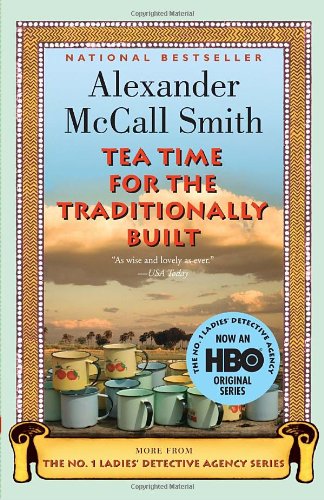
The twentieth book I read in 2015 is Tea Time for the Traditionally Built, the tenth book in the No. 1 Ladies' Detective Agency by Alexander McCall Smith.
I noted, back in book seven, the younger apprentice's continued lack of a name. Just as with my cavilling at Grace Makutsi's inexplicable tea preferences or lack thereof, it doesn't take long for Smith to respond to readers' ribbing on the issue. In this book, the younger apprentice's name is provided promptly and ostentatiously, with a winking conversation between Mmas Ramotswe and Makutsi that all but breaks the fourth wall: "We must start using his name. It is not kind to be forgetting it all the time." More than a name, the younger apprentice is also finally given his own characterization, rather than just Charlie's hanger-on, with a surprisingly moving glance into his home and family.
The main mystery of the book involves a local soccer team and its fortunes, but the real action centers on Violet Sephotho and her machinations to steal Mma Makutsi's fiance, Phuti Radiphuti. In addition, Mma Ramotswe suffers a loss to which Mr. J. L. B. Matekoni responds with both generosity and sensitivity.
Tuesday, March 31, 2015
Book review: Christianity on Trial by W. Mark Lanier
The nineteenth book I read in 2015 is Christianity on Trial: A Lawyer Examines the Christian Faith by W. Mark Lanier. This is a fairly standard book of apologetics, an updated Josh McDowell, right down to the gavel on the cover.
The most valuable contribution Lanier, a prominent trial lawyer, makes is in distinguishing between a courtroom, where the truth behind historical or anecdotal claims is sought, and a laboratory, where scientific facts are pursued. One cannot prove the existence of God in a laboratory, much less the historicity of the Gospels, any more than you can scientifically prove that George Washington was the first president of the United States. You don't go to science to learn about history; that's in the liberal arts building across campus. Too many people approach metaphysics as though it can be proven true or false by scientific test, like determining whether a substance is an acid or a base with litmus paper; instead, they should approach the question as if they were sitting on a jury and have to follow the preponderance of the evidence.
Apart from that, the most insightful paragraph I extracted was a quotation from another book: Your God is Too Small by J. B. Phillips:
It brought to mind the words of another great apologist: "He's not a tame Lion."
This is not a bad book, and it's engagingly written. It's just that if you've read any other works of apologetics, there's not really anything new here. If you haven't read any apologetics, this would be a fine place to start.
The most valuable contribution Lanier, a prominent trial lawyer, makes is in distinguishing between a courtroom, where the truth behind historical or anecdotal claims is sought, and a laboratory, where scientific facts are pursued. One cannot prove the existence of God in a laboratory, much less the historicity of the Gospels, any more than you can scientifically prove that George Washington was the first president of the United States. You don't go to science to learn about history; that's in the liberal arts building across campus. Too many people approach metaphysics as though it can be proven true or false by scientific test, like determining whether a substance is an acid or a base with litmus paper; instead, they should approach the question as if they were sitting on a jury and have to follow the preponderance of the evidence.
Apart from that, the most insightful paragraph I extracted was a quotation from another book: Your God is Too Small by J. B. Phillips:
"Those who are actively, though unconsciously, looking for a father- or mother-substitute can, by constant practice, readily imagine just such a convenient and comfortable god. They may call him 'Jesus' and even write nice little hymns about him, but he is not the Jesus of the Gospels, who certainly would have discouraged any sentimental flying to his bosom and often told men to go out and do most difficult and arduous things."
It brought to mind the words of another great apologist: "He's not a tame Lion."
This is not a bad book, and it's engagingly written. It's just that if you've read any other works of apologetics, there's not really anything new here. If you haven't read any apologetics, this would be a fine place to start.
Monday, March 30, 2015
Book review: The Miracle at Speedy Motors by Alexander McCall Smith
The eighteenth book I read in 2015 is book nine of the No. 1 Ladies' Detective Agency series, The Miracle at Speedy Motors by Alexander McCall Smith. In this installment, Phuti Radiphuti and Mma Makutsi go shopping for a bed for their shared home once they are married (beds, conveniently, not being stocked in the Double Comfort Furniture Store). They are taken advantage of by unethical tactics at close of sale, and things only get worse from there. Charlie and Mma Makutsi reach a probably-temporary truce over the tragic saga of the bed with the heart-shaped headboard.
In the meantime, Mr. J. L. B. Matekoni, given new hope that expensive medical science can heal Motholeli's paralysis, takes out a loan against Tlokweng Road Speedy Motors in order to pay for experimental treatment in Johannesburg, and Mma Ramotswe makes a sacrifice of her own to care for her family. In addition, the No. 1 Ladies' Detective Agency is receiving anonymous threats.
The "main" mystery has to do with a woman seeking her birth family, but that honestly takes a back seat to the daily trials and triumphs of the characters we've come to know and love.
Sunday, March 29, 2015
Book review: Fool Moon by Jim Butcher
The seventeenth book I read in 2015 was the second book of The Dresden Files. I'd heard of the series before, of course, but had never picked it up. On the recommendation of an acquaintance, I bought the first book, Storm Front, and read it last Thanksgivingish. It was ... eh ... all right. I found the book's presentation of women slightly creepy, and the final battle with the Big Bad depended on Harry handcuffing himself to a fixed object when the cuff was explicitly locked shut in an earlier scene and no keys available by which to open it. But pilots are always a little rocky, so I thought I'd give Jim Butcher another chance to impress me. Fifteen books and a short-lived TV series have to add up to something, right?
So I bought Fool Moon at Half-Price Books. It's about werewolves. Normally, I really don't like werewolves, so the fact that Butcher made his lycanthropes intriguing to me is a point in his favor. Here's the problem: I really don't like Harry Dresden. He is the least interesting character in his own books. His internal monologue is constantly yammering on about his innate nobility and how much richer he'd be and how many more women he'd have if only he weren't such a great guy, and I just hate him.
The most interesting recurring character in the two books I've read, by far, is Johnny Marcone. I'm supposed to think he's a bad guy. Harry certainly does. Johnny, a gentleman 'legitimate businessman,' repeatedly offers Harry mutually beneficial arrangements, but Harry, too pure to sully himself by being polite to someone who hasn't offered to harm him, just denounces him with the moral indignation of a motivational speaker. I would far rather read a series about Johnny Marcone navigating multiple shades of gray than about Harry Dresden riding his high horse along the straight and narrow.
Women, again, exist to be beautiful and either offer themselves up to Harry (who is, of course, far too pure of heart to agree) or die so that Harry can beat himself up about being unable to save the poor, helpless things. And Harry suffers multiple gunshots, maulings, and beatings to the brink of death yet is still able to run, climb, and fight mere minutes later in a manner that would impress Jack Bauer. Fool Moon even made TV Tropes for the distinction!
Tuesday, March 17, 2015
Book review: The Advocate by Randy Singer
The sixteenth book I read in 2015 was The Advocate by Randy Singer. I really, really enjoyed the first three hundred pages of this book in which Singer follows the career of a Roman lawyer through his education at the feet of Seneca and infatuation with a Vestal Virgin to his first posting in the backwater of Palestine as the result of political maneuvering. The depiction of daily life in first-century Rome is both immediate and engaging, and an outsider's perspective on the arrest and crucifixion of Jesus, while fictional, is believable and offers a new viewpoint on well-worn events.
Theophilus's return to Rome and prominence as the political tides shift is also a fascinating story, particularly the depiction of gladiators and Vestal Virgins as the professional sports heros and celebrity starlets of their society, and it culminates in a thrilling assassination plot that can be made to fit with historical fact.
The final one hundred fifty or so pages, however, became as flat and predictable as the first two-thirds of the book were riveting and surprising. The seemingly insurmountable obstacles to Theophilus's romantic happiness are conveniently surmounted; Paul's trial is as unbelievable as Jesus's was engaging (at one moment, witnesses to the risen Christ cannot be located given weeks of searching the far reaches of the empire by multiple investigators, whereas a few weeks later, there are a couple literally living within Rome itself with Paul's full knowledge); and the whole thing climaxes in Fox's-Book-of-Martyrs-style torture-porn as the Christian converts are executed in the most gruesome ways possible. (Sorry, spoiler-alert, but if you don't know what's coming when Nero takes the throne, you might want to read some more history.)
I'd advise reading first three hundred or so pages of the book as a thoroughly engaging fictional look at Roman life and history. The end turns into any other poorly-written Christian historical fiction paperback you picked up for a few bucks at the Christian bookstore.
Monday, March 16, 2015
Book review: Sidney Chambers and the Perils of the Night by James Runcie
The fifteenth book I read in 2015 was the second book of The Grantchester Mysteries, Sidney Chambers and the Perils of the Night by James Runcie. My review of the first book of the series was not glowing, and this second installment only exacerbates my annoyances with the first one.
For one thing, while the first book covered less than two years, the second opens in January of 1955 and ends in 1961. This ameliorates the "Murder, She Wrote" problem with suspension of disbelief, where one begins to wonder how anyone stays alive around Jessica Fletcher since she's always stumbling across murder victims in her small town, but it kills verisimilitude in another sense: In six years, literally nothing changes, not only in Sidney's life but in the lives of anyone around him. No one marries or divorces or changes jobs or moves or has a child. His sister is still dating the same man she was in 1953 without any mention of marriage, and neither of the two other vertices in Sidney's tiresome love triangle have gone anywhere over the course of eight years. Frankly, this stagnancy is less believable than Cabot Cove's sky-high murder rate.
In addition, Canon Chambers continues completely to fail to be a compelling character with any depth at all. There's actually a scene in which he is discovered and threatened by the murderer he is about to unmask which ought to be awash with tension, but instead it's, well, this:
Honestly, considering this is the same level of passion he's able to gin up for either of his love interests, I guess it oughtn't to be a surprise he's done nothing about it for eight years.
Perhaps the greatest flaw of the series is that Runcie 'cheats' at writing mysteries. While real detectives can have hunches, fictional detectives aren't allowed to; part of the fun of reading a mystery is the opportunity to try to pick up on the clues in the text and solve the crime before the big reveal. When the baffled police protest, "But how did you know?" the protagonist is supposed to respond with some small piece of evidence that didn't add up, not with a vague "Oh, well, I just had a feeling he might have been guilty...."
Even worse, the actual in-universe detective work is just as lackadaisical. At one point, Sidney and Inspector Keating are examining the scene from which a man disappeared: "Montague's story suggests that Bartlett disappeared by running the length of the roof and disappearing through a concealed doorway in the south-west pinnacle." Is this conjecture followed by the two men walking the ridgepole of the roof and discovered said concealed portal, perhaps leading to a further clue: a footprint or the thread off a torn sleeve, anything? Nope, they just opine that it certainly could have happened that way and go back downstairs without even investigating whether Montague's theoretical escape route even exists. Tremendously sloppy.
My intention of following through the rest of the series, however half-heartedly, has been weakened by this lackluster second installment.
For one thing, while the first book covered less than two years, the second opens in January of 1955 and ends in 1961. This ameliorates the "Murder, She Wrote" problem with suspension of disbelief, where one begins to wonder how anyone stays alive around Jessica Fletcher since she's always stumbling across murder victims in her small town, but it kills verisimilitude in another sense: In six years, literally nothing changes, not only in Sidney's life but in the lives of anyone around him. No one marries or divorces or changes jobs or moves or has a child. His sister is still dating the same man she was in 1953 without any mention of marriage, and neither of the two other vertices in Sidney's tiresome love triangle have gone anywhere over the course of eight years. Frankly, this stagnancy is less believable than Cabot Cove's sky-high murder rate.
In addition, Canon Chambers continues completely to fail to be a compelling character with any depth at all. There's actually a scene in which he is discovered and threatened by the murderer he is about to unmask which ought to be awash with tension, but instead it's, well, this:
"[Name redacted] lunged forward. Sidney picked up a chair and threw it in his way. He was going to have to get to the door as soon as he could."
Honestly, considering this is the same level of passion he's able to gin up for either of his love interests, I guess it oughtn't to be a surprise he's done nothing about it for eight years.
Perhaps the greatest flaw of the series is that Runcie 'cheats' at writing mysteries. While real detectives can have hunches, fictional detectives aren't allowed to; part of the fun of reading a mystery is the opportunity to try to pick up on the clues in the text and solve the crime before the big reveal. When the baffled police protest, "But how did you know?" the protagonist is supposed to respond with some small piece of evidence that didn't add up, not with a vague "Oh, well, I just had a feeling he might have been guilty...."
Even worse, the actual in-universe detective work is just as lackadaisical. At one point, Sidney and Inspector Keating are examining the scene from which a man disappeared: "Montague's story suggests that Bartlett disappeared by running the length of the roof and disappearing through a concealed doorway in the south-west pinnacle." Is this conjecture followed by the two men walking the ridgepole of the roof and discovered said concealed portal, perhaps leading to a further clue: a footprint or the thread off a torn sleeve, anything? Nope, they just opine that it certainly could have happened that way and go back downstairs without even investigating whether Montague's theoretical escape route even exists. Tremendously sloppy.
My intention of following through the rest of the series, however half-heartedly, has been weakened by this lackluster second installment.
Subscribe to:
Posts (Atom)
Blog Archive
Labels
- Agatha Christie (3)
- Alexander McCall Smith (23)
- apologia pro sua vita (49)
- Art Linkletter (29)
- Austeniana (10)
- bibliography (248)
- birthday (21)
- Charles Lenox (3)
- Christmas (29)
- deep thoughts by Jack Handy (16)
- Grantchester Mysteries (4)
- Halloween (10)
- high horse (55)
- Holly Homemaker (19)
- Hornblower (3)
- Inspector Alan Grant (6)
- Isabel Dalhousie (8)
- life-changing magic! (5)
- Lord Peter Wimsey (6)
- Maisie Dobbs (9)
- Mark Forsyth (2)
- Mother-Daughter Book Club (9)
- No. 1 Ladies' Detective Agency (14)
- photo opportunity (103)
- pop goes the culture (73)
- rampant silliness (17)
- refrigerator door (11)
- Rosemary Sutcliff (9)
- something borrowed (73)
- the grandeur that was (11)
- where the time goes (70)