Wednesday, November 18, 2015

Book review: Thrones, Dominations by Dorothy L. Sayers and Jill Paton Walsh

When I read The Nine Tailors and the last stories in Lord Peter, in one sense, I had read all there was to read about Lord Peter Wimsey.  However, I already knew that a contemporary novelist, Jill Paton Walsh, had been given permission by the Sayers estate to write more.  'Authorized sequels' can be a dubious proposition (Scarlett, anyone?), but I thought I'd give them a chance.

As a result, the forty-third book I read in 2015 was Thrones, Dominations, with the double by-line of Sayers and Walsh.  According to Wikipedia, Sayers began work on Thrones, Dominations with a view to comparing Lord Peter's and Harriet's new marriage with that of two other couples but abandoned it in the face of political events in Europe in the latter half of the 1930s after completing approximately the first six chapters.

That's where Jill Paton Walsh comes in.  I'd like to say the transition is seamless, but....  Her command of the language is admirable: Lord Peter and Harriet, in the main, sound like themselves.  I suspect Paton Walsh of being the hand behind the excerpts from the Dowager Duchess's diary, which are distractingly of-the-moment, mentioning then-current events and personalities with a specificity Sayers avoided.  I hope she is the originator of some glaring new characters, including Harriet's lady's maid and Bunter's sudden and distracting love interest, who seem to be introduced with a passion for making things fair: If Lord Peter gets a romance, so must his lower-class right-hand man, and if Lord Peter has a live-in assistant, so must Harriet.

More unforgiveably, both Lord Peter and Harriet are much less intelligent and able in this novel than in the previous Sayers-penned ones.  Harriet convinces a neglected wife to take a weekend in the country; when something unpleasant occurs and everyone is trying to figure out why she was there, it's a whole chapter before Harriet suddenly recalls the fact; later on, Harriet notices a clue as Lord Peter and Inspector Parker discuss the case and begins to raise a question ... but Inspector Parker talks over her, Lord Peter allows him to (out of character), and Harriet doesn't bother bringing the point up again (even more out of character) until the men handle it chapters later and she says oh, yes, I thought that was strange but didn't say anything.

Paton Walsh has produced a serviceable detective novel set in the 1930s, but it is, in the final analysis, not a Lord Peter Wimsey novel.

Tuesday, November 17, 2015

The Sexy Dinosaur

On the subject of the depiction of women in fantasy art, in one of these pictures Wonder Woman is wearing, well, as many clothes as she ever does, and in the other she's entirely naked, save for a strategically-placed sheet; and yet, the "fully-clothed" Wonder Woman is far less offensive (also, far less top-heavy).

Blogger David Brothers compares art of the same character as drawn by different artists -- Wonder Woman, here, and Psylocke (who, frankly, I've never heard of, but whatever), here -- and demonstrates that it's not about how heavily-clothed a female character is (contra those who shout that those who object to women being sexualized in popular culture want to put them in burqas) but about depicting women as competent independent agents rather than pin-up dolls that exist to be super-sexy.  It's like Halloween costumes for women: Sexy Pirate, Sexy Minion, Sexy Dinosaur, whereas men can just be Pirate, Minion, Dinosaur.

And, just for fun, here's what one of the most reviled comic-cover poses really looks like when modeled in 3D.

Monday, November 16, 2015

Book review: The Triumph of Caesar by Steven Saylor

I was browsing the clearance section of the local Half Price Books when I spotted a familiar name on a spine: Steven Saylor.  In my first year of college, spring semester of 1992, I took a Roman Civ & Culture class that had, as one of its requirements, to read a work of fiction set in Ancient Rome.  The book I selected was a detective story starring Gordianus the Finder, Roman Blood, by a first-time novelist named Steven Saylor.

I knew Saylor had written some sequels, as I kept up with them for a book or two, borrowing them from the library in my hometown during vacations, but after moving away for grad school, I completely forgot about them until I saw this hardcover on the shelf.  Could he possibly still be writing Gordianus books? I wondered.

The answer, as it turns out, was yes.  The forty-second book I read in 2015 was The Triumph of Caesar, the twelfth in the series.  Despite not having given the series any thought in twenty-odd years, I remembered Gordianus, and even a few of the supporting characters seemed familiar from the first three books.  Set more than thirty years after the first installment, The Triumph of Caesar finds Gordianus nearing the end of his career.  His career as Finder has proved relatively lucrative and has won him powerful friends; the story opens with Julius Caesar's wife seeking Gordianus's help in uncovering what she believes to be a threat on Caesar's life during the week of his Triumph, a series of parades celebrating his victories in Egypt and elsewhere.

A bit too much of the didact comes through at times -- dialogue in which the characters over-explain everyday habits to each other, "As you, of course, know, it has long been our custom to...."  Still, to reacquaint myself with Gordianus after such a long time in such a serendipitous way was a delight, and it motivated me to seek out the rest of the series, both the ones I read twenty years ago and have largely forgotten, and the ones I missed.

Sunday, November 15, 2015

Book review: Death by Living by N. D. Wilson

The truth is that a life well lived is always lived on a rising scale of difficulty.
As a little kid, I had a job: Obey my mother. Don't lie. Play hard. Be nice to my sisters.
At the time, that job was actually difficult. My mom kept saying things like, "Come here." And, "No jumping on the couch." Or, "Don't stand on the doorknob and swing on the door." And, "No hitting."
But my sisters were there, and so were my fists. The couch was bouncy. Doors are cool to swing on.
Man, I was bad at my job.
The forty-first book I read in 2015 was Death by Living: Life Is Meant to Be Spent by N. D. Wilson.   Wilson is best known, I would imagine, as the author of young adult fantasy, including the 100 Cupboards series, but this is a devotional book.  Or possibly "Christian living."  I've never been entirely clear on the distinction between the two.

Wilson's thesis is that we ought all to live in consciousness of the inevitability of death.  Not only does it orient us to live less self-centered lives ("If you were suddenly given more than you could count, and you couldn't keep any of it for yourself, what would you do?  This is, after all, our current situation."), it is a positive mercy to mankind struggling to overcome his sinful nature: "In the ancient myths, Tartarus is where the revel Titans were tortured forever, where they struggled to complete tasks without any end, without any completion.  Without death, without mortal time, this earth would be Tartarus."

A life well-lived is always lived on a rising scale of difficulty.  The last enemy to be conquered is death.

Saturday, November 14, 2015

Book review: Lord Peter by Dorothy L. Sayers

When I read my last Lord Peter novel, it wasn't my last Lord Peter mystery.  Dorothy Sayers also wrote several short stories starring the noble sleuth which are collected in Lord Peter: The Complete Lord Peter Wimsey Stories.  The collection isn't the fortieth book I read in 2015, as I read the stories folded in with the novels in the order of their publication, but it was the fortieth book I finished.

A Lord Peter short story is a very different experience than a Lord Peter novel.  There just isn't room enough or time for the multitude of clues and characters that accrue in a longer work, and there's less of a deductive unraveling of the case and more of a flash of inspiration that solves it.  As such, the Lord Peter of the short stories comes across significantly more superhuman than he does in the novels.  The plots are rather more sensational, as well, perhaps to quickly seize the attention of a reader flipping through the pages of a magazine.  On the whole, I much prefer the novels.

The collection is chiefly notable for the last two stories, which take place after the last Lord Peter Wimsey/Harriet Vane novel and give us a glimpse of life after their honeymoon: "The Haunted Policeman" takes place the night their first child is born, and "Talboys" is set some years later when they have three young sons.  "Talboys" in particular sets the mind at rest about whether letting the romantic leads get married means the end of the line creatively; had Sayers chosen to continue writing books about Lord Peter, the quality of the story is reassuring that she could have done so with no drop-off in quality -- even if the mystery in question is only who stole the local farmer's peaches rather than a murder.


Friday, November 13, 2015

Book review: The Bookseller by Cynthia Swanson

The thirty-ninth book I read in 2015 was The Bookseller by Cynthia Swanson. Set in Denver in the early 1960s, it tells the story of a woman living two lives: in one, a successful single career woman running a bookstore with her best friend, in the other, a happily-married mother of small children.  When she falls asleep in one life, she wakes up in the other.

For a while, she merely enjoys what she considers to be a vivid recurring dream, exploring the road not taken, but eventually she must decide which of the two worlds she is experiencing is the real one -- and which she wants to be.

Apart from the implied supernatural element, I was also drawn to this book because my mother was a single woman in Colorado for a while in the 1960s, albeit in Boulder rather than Denver.  I very much enjoyed it.  Each of the realities the protagonist (Kitty in one life, Katharyn in the other) experiences is rich and believable, and I went back and forth in my own mind over the course of the narrative over which one was "real."  Even more impressive, the final resolution felt earned, rather than a cheap or trite cop-out ending.  This was Cynthia Swanson's first novel, and I'll certainly be interesting in taking a look at her second.


Tuesday, November 10, 2015

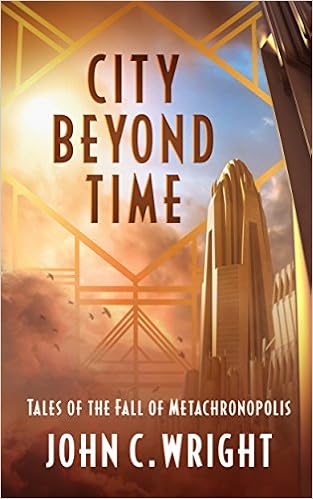
Book review: City Beyond Time by John C. Wright

The thirty-eighth book I read in 2015 was City Beyond Time: Tales of the Fall of Metachronopolis by John C. Wright.  I read it on my Kindle, drawn in by a free preview of a non-linear story which jumped forward and backward in time in the telling.  "Murder in Metachronopolis" begins

16.
Third beginning:
I woke up when my gun jumped into my hand.

If you can resist trying to unravel a noir detective story told out of order, you're a better man than I.

"Murder in Metachronopolis" is by far the best story of the six, but it was worth the price of the e-book, particularly since I paid most of the $4.99 with promotional credits I'd accumulated from various other Amazon purchases.  The protagonist of "Murder," Jacob Frontino, returns in the last story, "The Plural of Helen of Troy," which is the second best of the collection.  The stories that don't feature him are standard "Twilight Zone"/"The Outer Limits" fare.

At the time I read the book, I was unaware of the Hugo Award kerfuffle.  I can verify that Wright's female characters are underwritten and antithetical to the Bechdel test, as they're defined entirely by their relationships with men.  The Jacob Frontino stories suffer least, as -- hello!  they're in the noir detective genre, where women are femme fatales, hookers with hearts of gold, girls-next-door, or gals Friday.  

I don't take a side in the actual controversy.  I liked this book a lot, but I also loved Redshirts by John Scalzi, who is on the opposite side of the argument; and both the dinosaur stories are execrable, but the Sad Puppy one at least has the distinction of actually being science fiction.  

Blog Archive