Sunday, May 8, 2016

Book review: The Handsome Man's Deluxe Cafe by Alexander McCall Smith

The eleventh book I read in 2016 was The Handsome Man's Deluxe Cafe, the fifteenth installment in the No. 1 Ladies' Detective Agency series by Alexander McCall Smith.  This was the first of the Mma Ramotswe books that I felt fell a little flat.

The titular cafe is an ill-considered business venture by Mma Makutsi, in which she is thoroughly taken advantage of and played the fool.  The A-plot involves a woman who claims to be an amnesiac and whose identity Mma Ramotswe is hired to discover.  And the side-plot involves both Mr. J. L. B. Matekoni and Mma Ramotswe not having enough money to keep all the recurring characters employed.

For one thing, at this point in the series, I don't like seeing beloved characters struggling.  A story about Speedy Motors or the No. 1 Ladies' Detective Agency going out of business is not one I'm interested in reading.  It's been a given that the detective agency is bumping along basically breaking even, but Tlokweng Road Speedy Motors has always been portrayed as a going concern.  And I felt bad enough for Grace Makutsi back before her marriage when the glamorous and expensive headboard purchased for her marriage bed was ruined because her tiny apartment was too small to hold it; dashing her hopes and ambitions again is too cruel.

For another thing, all of the plots are solved, not by Mma Ramotswe or Mma Makutsi, but by Mma Potokwane.  One doesn't read a Sherlock Holmes story to have Inspector LeStrade step in and save the day.

Saturday, May 7, 2016

Book review: Miss Pym Disposes by Josephine Tey

The tenth book I read in 2016 was my last Josephine Tey novel, Miss Pym Disposes.  Very different from her Alan Grant series, this book deals with a single woman who has rather surprised herself by writing a book on a hot topic which has brought her considerable fame and respect -- and the ability to quit her day job.  Lucy Pym accepts an invitation from an old school acquaintance who is now the headmistress of a girls' physical training college to give a lecture to the student body.  She is charmed enough by her re-entry into the company of the young and female to agree to stay on rather indefinitely through the end of the term.

A physical training college must have been a remarkable thing.  I spent a great deal of the book trying to figure out exactly what the girls were training to be.  It seems to have involved both anatomy and medical studies and sports, dance, gymnastics, and calisthenics, which is a double-bill one would be hard pressed to find today.  One doesn't go to Harvard Medical and Tennis.  It would seem that, once physically trained, the girls go on either to medical clinics or to sportsmistress positions at girls' schools, the latter of which is more prestigious.

If one didn't know that one was reading a Josephine Tey book and hadn't read the back-cover blurb promising a murder, one would think that this was simply a book about life among the students and faculty in a girls' college.  It's not that it's not an enjoyable read, without the promise of bloodshed, but if you're reading for the murder mystery, be aware that that aspect doesn't turn up until you're three-quarters of the way through the book.  I rather wish I hadn't read the blurb, as, as much as I was enjoying it, I kept thinking, "Yes, and...?  When are we going to get to it?"  I would characterize this more as a book in which a murder plays a role than as a murder mystery.  (And unlike most of Tey's other books, I was able to predict the killer in this case.)

Friday, May 6, 2016

Book review: The Minor Adjustment Beauty Salon by Alexander McCall Smith

The ninth book I read in 2016 was the fourteenth book in Alexander McCall Smith's No. 1 Ladies' Detective Agency series, The Minor Adjustment Beauty Salon.  In it, Mma Ramotswe deals with two cases.  The primary one has to do with an heir who may not be who he says he is; the secondary one is the one which provides the book's title, when the Minor Adjustment Beauty Salon is the victim of a malicious whisper campaign which threatens to put it out of business.  Both cases are dealt with in a manner unusual to detective novels in general but quite in character with Precious Ramotswe's methods, where reconciliation outweighs the exaction of justice and even the facts themselves.

The major development of the book, however, is the birth of Phuti and Grace Radiphuti's first child.  There is a bit of tension with Mma Makutsi's pregnancy: real tragedies have been few and far between in the series, but Mma Makutsi's hard-earned and well-deserved happiness always feels somewhat precarious.  The real disruption, however, comes when Mma Makutsi leaves the agency.  Despite having begun the business solo, Mma Ramotswe has had Mma Makutsi by her side virtually from the beginning.  The book ends with an act of love and generosity which cements the relationship between the two women.

Wednesday, May 4, 2016

Book review: The Lantern Bearers by Rosemary Sutcliff

The eighth book I read in 2016 was The Lantern Bearers by Rosemary Sutcliff, the final volume in what's referred to as her Roman Britain trilogy, following The Eagle of the Ninth and The Silver Branch, though Wikipedia lists eight books in the series.  These three appear to be the only ones readily available in a recent edition.

The Lantern Bearers is set something over a hundred years after The Silver Branch and opens with the latest descendents of Marcus and Cottia at home on the land he earned in The Eagle of the Ninth.  It is now a farm, though due to the retreat of ever-more-beleaguered Rome and the constant threat of Saxon raiders, its best days are behind it.  Young Aquila, like his forebears, serves in the Roman army stationed at Rutupiae, but when the last of the Roman troops are ordered back to defend the empire's nearer holdings, he deserts to make a last stand defending his family and his ancestors' lands.  Denied the death he expects, Aquila is left to live, first as a thrall to his Saxon enemies, then as a renegade, trying to find something to believe in when he has lost everything he has ever known and loved.

This is an excellent book, but it's much more bitter than its predecessors.  Eagle is full of hope for a future in a new land, and Branch at least holds out the hope of saving something from the oncoming disaster; The Lantern Bearers is a book about living in, and after, defeat.  Any novel which opens with a beloved sister ecstatically proclaiming how she loves being alive is going to close with her not: it's a corollary of Chekhov's Gun.  So, really, don't read this book thinking it's going to end well.

In spite of the general theme of loss, however, there are some striking depictions of hope in this book. Aquila, having deserted the ships just before they carry his fellow soldiers away, lights the lighthouse one last time; it is a beautiful image and, later in the story, revealed to have been a consolation in a time of trial to others.  And Brother Ninnias, the lone surviving monk of his monastery after it is overrun by Saxons, both warms and breaks the heart in the kindness and steadfast faith he shows to Aquila and the others left behind by Rome.

At the same time as The Lantern Bearers ends the Roman Britain trilogy, it can also be seen as a prequel to The Shining Company, itself a book accustomed to loss and resigned to defeat without giving in to bitterness and despair.

Tuesday, May 3, 2016

Book review: The Singing Sands by Josephine Tey

The seventh book I read in 2016 was the last of Josephine Tey's Alan Grant novels, The Singing Sands.  Inspector Grant is taking a leave of absence due to his nerves: a case of what we would today call claustrophobia.  Leaving behind the stresses of his job and the crowds of London, he is heading for a fishing holiday with family in Scotland when the sudden, unexplained death of a fellow passenger on his train intervenes to keep his mind off relaxation.

The title of the book derives from an incomplete snatch of verse written in the verge of the dead man's newspaper, a stanza which could have been left on the cutting room floor of Coleridge's "Kubla Khan":
The beasts that talk,

The streams that stand,

The stones that walk,

The singing sand,

.........

.........

That guard the way

To Paradise.
These lines haunt Grant and, despite his best intentions to relax and forget about his job back home, entice him to investigate what has already been written off by Scotland Yard as an accidental death.

In the course of his investigation, he meets a Scots nationalist, a young and eligible widow, a pilot, and a scholar.  In the end, he not only unravels the identities of both the dead man and his murderer but also plays a part in the discovery of a long-lost Xanadu -- and, incidentally, overcomes his fits of nerves and returns rejuvenated to the force.

Wednesday, April 27, 2016

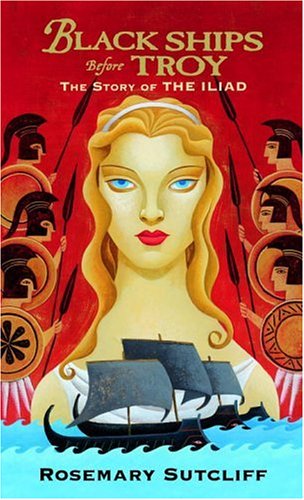
Book review: Black Ships Before Troy by Rosemary Sutcliff

The sixth book I read in 2016 was Black Ships Before Troy: The Story of the Iliad by Rosemary Sutcliff.  I picked it up in Half Price Books because I have enjoyed her Roman Britain books so much.

This is a very different book, however; rather than setting her own characters within a historic milieu, she sets out a straightforward retelling of the Greek epic from the original Homer.  I never read the Iliad straight through; but we did the Odyssey in 9th grade English, and the Homerisms are evident, from grey-eyed Athene to the wine-dark sea, as well as the interminable funeral games, which are thankfully abbreviated in this telling.

One is struck by the Trojans' dumb tactics, as they have various allies arriving throughout the seige and, instead of waiting until they're all there and launching a coordinated assault on the Greeks, one set of allies arrives, attacks, and is wiped out before the next group of allies shows up.  But the whole point of the Greek worldview is that mortals don't have any agency but serve as pawns of the gods, so I guess Troy was fated to fall anyway.  Thus Virgil would have one believe, at any rate.

This would make a good classroom text for a middle school study of Classical history.

Tuesday, April 26, 2016

Book review: Misreading Scripture with Western Eyes by E. Randolph Richards & Brandon J. O'Brien

The fifth book I read in 2016 was Misreading Scripture with Western Eyes: Removing Cultural Blinders to Better Understand the Bible by E. Randolph Richards and Brandon J. O'Brien.  Having already read Kenneth E. Bailey's books on reading the Bible through a lens informed by the culture of the Middle East, I expected this to be a similar work, written more for a layman's perspective, and I wasn't wrong.

This is certainly a simpler book, but it is also inferior to Bailey's works in more troubling ways.  For one, Bailey makes it clear that the Middle Eastern culture is unique and that to understand the biblical accounts as they would have been understood by their original writers and readers, one must have an understanding of their worldview.  Richards and O'Brien make a point in their introduction that human beings tend to be binary in their thinking -- Western/Eastern, good/bad, right/wrong -- but that reality often has more than two options; however, by choosing the "Western" worldview to denigrate, they absolutely do imply that the "Eastern" way is more biblical.  The book could more accurately and less sensationally have been titled Misreading Scripture with American, Evangelical Eyes.  I very strongly question the right of a couple of guys from a Baptist college in Florida to speak for Europe and North America as a whole, particularly when one of the blockbuster tidbits they drop is that Fanny is a girl's name in America but a rude, scatological term for female genitalia in England.  Apparently, they've never heard of Fanny Burney, one of the most famous woman authors in England, or Fanny Price, heroine of the British Jane Austen's celebrated novel Mansfield Park.  Such blatant ignorance does not predispose me to take their word on anything else they assert.

In addition, as opposed to Bailey's work, which is proffered in a spirit of humility and based on a lifetime of crosscultural immersion, there is a very strong sense of condescension toward American evangelicals in Misreading Scripture.  Richards and O'Brien repeatedly assume that American Christians (despite the misleading title of their book, the focus is only and always on Americans, not Europeans) are jingoistic, xenophobic racists.  "We won't even dare to consider the prejudice that some North American Christians might express [if a Korean missionary came to North America]."  Really?  Then don't consider it, and certainly don't put it in a snide endnote.

There is sadly more than a whiff of "I thank God I am not as other men, even these Americans" which pervades the whole book.  I would certainly recommend that readers pick up Kenneth E. Bailey's Jesus Through Middle Eastern Eyes and Paul Through Mediterranean Eyes, despite their greater length and more intellectually demanding nature, before this book.

Blog Archive