The forty-seventh book I read in 2018 was Goblins!: The Adventure of the Wise Wench by Richard Pett. Pett is largely known as a creator of adventures and campaign settings for roleplaying games, and he is clearly influenced here by the goblins of Golarion, the setting of the Pathfinder RPG. Pett, in fact, wrote We Be Goblins!, a justly-famous adventure created for Free RPG Day in 2011, in which the players get to play, well, goblins (which usually play the role of easy-to-kill speedbumps in the way of player characters). Goblins! is basically We Be Goblins!: The Novel, which means it is a great deal of fun.
Goblins are violent, lazy, stupid, comically-incompetent creatures, with the possible exceptions of their females, some gifted specimens of which gain the role of Wise Wench, and Urgh Tricksy, sometimes known as Upside Down Face because his head is on the wrong way, with the mouth at the top and eyes at the bottom. Urgh is informed by the Wise Wench, who traffics with such gods as Lord Noc, Demigod of All Wind, and the dreaded Queen Quench, the Moist One, Queen of Boring, the Extinguisher of Bonfires, Bringer of Black, Lady Funless, Madam Dull-and-Damp, Mistress Tedium, the Insipid Crown Princess of Dreary, the Bore, and thus knows everything that is going to happen, that he is destined to become the village hero.
Along with his companion Sorry and Moaris the Minor Apocalypse, son of BigBad Chief Runty Miffed, a sort of goblin Lord Flashheart, Urgh sets forth on a quest to save the goblins of the forest from the invading giants, a species which has all the vices of goblins but is bigger -- and we all want to root for the underdog. While the heroes are off on their quest, the giants must be held off by the vain King Stormgrunties, his adviser Looti Lovelilips, Head Thug Durth Dimbits, and Master Whippet by such means as an iron hamster, a giant nose, and -- worst all all -- the king's own clever ideas.
Pett leaves the door wide open for a sequel -- indeed, the Wise Wench at one point confuses this quest with one that she and Urgh will be on in the future -- and if it comes to be, I will be first in line to read it.
Friday, November 9, 2018
Monday, November 5, 2018
Book review: The Warner Boys by Curt and Ana Warner
The forty-sixth book I read in 2018 was The Warner Boys: Our Family's Story of Autism and Hope by Curt and Ana Warner. It was an Amazon First Reads book for the month of November, and when I saw it was by former NFL player Curt Warner, I thought of the Rams quarterback. That was Kurt Warner, however; Curt was from back in the '80's, before I had any interest in football.
Curt Warner was raised by his grandparents in West Virginia and took football as an opportunity not to become a coal miner. He went to Penn State and then was drafted, behind John Elway and Eric Dickerson, by the Seahawks. His life in football is covered in a few chapters, as the focus of this book is on his family, particularly on twin boys with autism.
Curt and his wife Ana alternate first-person accounts, with an interlude by their older son giving his perspective, detailing their family life. Despite the twins Austin and Christian's symptoms reading as textbook autism today, in the late 1990s, they boys went undiagnosed until they were five. Even after diagnosis, nothing about the situation got any easier; there was only a sense of relief that they could give the problem a name.
I'm sure it is not the Warner's intention, but this book left me horrified and exhausted. The twins were aggressive and destructive, harmful both to themselves and to others. They required constant supervision for years. They did structural damage to the family's home; then, when it had just been freshly remodeled to be more resilient, they started a fire which burned it down. While the narrative elicits greater sympathy for families dealing with autism, the relentless intensity of that life rendered me numb, not inspired to dive in and get involved but wanting to withdraw and hide from the gritty details revealed.
One thing that impressed me: Ana tells of desperate days as a stay-at-home mother, when she regularly called the prayer line of a local Christian radio station. When they hadn't heard from her in a couple of days, the people at the station actually called her to make sure she was all right. I have to admit, I've rolled my eyes at the "let us pray for your request" options I've heard on Christian radio, but may God bless those people for actually caring.
Curt Warner was raised by his grandparents in West Virginia and took football as an opportunity not to become a coal miner. He went to Penn State and then was drafted, behind John Elway and Eric Dickerson, by the Seahawks. His life in football is covered in a few chapters, as the focus of this book is on his family, particularly on twin boys with autism.
Curt and his wife Ana alternate first-person accounts, with an interlude by their older son giving his perspective, detailing their family life. Despite the twins Austin and Christian's symptoms reading as textbook autism today, in the late 1990s, they boys went undiagnosed until they were five. Even after diagnosis, nothing about the situation got any easier; there was only a sense of relief that they could give the problem a name.
I'm sure it is not the Warner's intention, but this book left me horrified and exhausted. The twins were aggressive and destructive, harmful both to themselves and to others. They required constant supervision for years. They did structural damage to the family's home; then, when it had just been freshly remodeled to be more resilient, they started a fire which burned it down. While the narrative elicits greater sympathy for families dealing with autism, the relentless intensity of that life rendered me numb, not inspired to dive in and get involved but wanting to withdraw and hide from the gritty details revealed.
One thing that impressed me: Ana tells of desperate days as a stay-at-home mother, when she regularly called the prayer line of a local Christian radio station. When they hadn't heard from her in a couple of days, the people at the station actually called her to make sure she was all right. I have to admit, I've rolled my eyes at the "let us pray for your request" options I've heard on Christian radio, but may God bless those people for actually caring.
Thursday, November 1, 2018
Book review: Killing Kryptonite by John Bevere
The forty-fifth book I read in 2018 was Killing Kryptonite: Destroy What Steals Your Strength by John Bevere. The first thing I'll point out is that Bever changes verb tenses between the title and subtitle, going from present participle to present imperative. The second thing I'll point out is that "killing kryptonite" is weird metaphor, since kryptonite is a mineral and can't be "killed." And if I'm getting this pedantic this early, you know this can't be a rave review.
I picked up this book because Bevere wrote one of my favorite Christian living book(let)s of all time, How to Respond When You Feel Mistreated. On that basis, when I saw this new release for $5 at the Mardel checkout, I was eager to give it a chance.
Unfortunately, the first part of this book is very weak, in my opinion. It is the author's assertion that the cessation of miracles in the church is due to sin in the body, that the acts of the apostles were meant to be the pattern of the church for the last two thousand years, and that the only reason that the shadow of a passing Christian falling on a sick person isn't instantly healing them is because the local church tolerates members who are unrepentant. His basis for this reasoning is 1 Corinthians 11:30, Paul's blaming physical illness on improper administration of the Lord's Supper. I find this a utopian argument, difficult to square with a more holistic view of the New Testament which emphasizes that believers should not be surprised by suffering. While Bevere disavows the prosperity gospel, his teaching, taken to its logical end, is little different.
Bevere's ultimate argument, that the church is weakened by the tolerance of sin in its membership, is convincing, and his concomitant condemnation of a cheap-grace gospel which depends on persuading people to "ask Jesus in their hearts" without an accompanying emphasis on repentance and a changed life, is worth pondering. A personal anecdote about the Dallas Cowboys is convicting. However, in my opinion, Bevere's argument is weakened by an overstatement of the potential consequences of following his advice.
I picked up this book because Bevere wrote one of my favorite Christian living book(let)s of all time, How to Respond When You Feel Mistreated. On that basis, when I saw this new release for $5 at the Mardel checkout, I was eager to give it a chance.
Unfortunately, the first part of this book is very weak, in my opinion. It is the author's assertion that the cessation of miracles in the church is due to sin in the body, that the acts of the apostles were meant to be the pattern of the church for the last two thousand years, and that the only reason that the shadow of a passing Christian falling on a sick person isn't instantly healing them is because the local church tolerates members who are unrepentant. His basis for this reasoning is 1 Corinthians 11:30, Paul's blaming physical illness on improper administration of the Lord's Supper. I find this a utopian argument, difficult to square with a more holistic view of the New Testament which emphasizes that believers should not be surprised by suffering. While Bevere disavows the prosperity gospel, his teaching, taken to its logical end, is little different.
Bevere's ultimate argument, that the church is weakened by the tolerance of sin in its membership, is convincing, and his concomitant condemnation of a cheap-grace gospel which depends on persuading people to "ask Jesus in their hearts" without an accompanying emphasis on repentance and a changed life, is worth pondering. A personal anecdote about the Dallas Cowboys is convicting. However, in my opinion, Bevere's argument is weakened by an overstatement of the potential consequences of following his advice.
Saturday, October 27, 2018
Book review: You Might Remember Me by Mike Thomas
The forty-fourth book I read in 2018 was You Might Remember Me: The Life and Times of Phil Hartman by Mike Thomas. Phil Hartman is largely known for four things: Saturday Night Live, The Simpsons, NewsRadio, and his murder at the hands of his wife in 1998 at the age of fifty.
Unfortunately, I have found that most (auto)biographies I have read leave me with a worse opinion of their subjects than I held in blissful ignorance. (See: Van Dyke, Dick and Schulz, Charles.) Hartman is no exception. He was born in small-town Canada, but a trip to the Rose Bowl infected his parents with the Southern California dream, where they determined to relocate their family as soon as possible. One can't help but question whether staying in Canada might not have resulted in a better outcome for their children, though it may have robbed television audiences of Phil's unquestionable comedic talent, as Phil and at least one brother became enthusiastic partakers of the 1960s celebrity culture of sex, drugs, and rock'n'roll.
The Hartmanns (a numerology-influenced Phil dropped the extra N for better karma) were a Catholic family with the multiple siblings that implies, one of whom was severely disabled. It is unclear whether it is Phil or his biographer or both that blamed his disabled sister for robbing him of the parental attention he rightfully deserved, but it's an unattractive sentiment poorly expressed. Phil's distant and unsuccessful relationships with three wives likewise indicate an inability to connect and empathize with other human beings when it's inconvenient or upsetting, and his complaint about the "trailer parks across America" which, in preferring the Brett Butler family sitcom Grace Under Fire over the urban singles workplace comedy NewsRadio, denied him the success he felt was his due, displays a contempt for the very audience he hoped to win over. (Full disclosure: I have watched and enjoyed both.)
In the end, of course, the story is a tragedy, not only for Phil and his fans but for his wife and murderer Brynn, whose motivations and mental state will never be fully understood but whose subsequent remorse and suicide robbed her children of both parents. The final fifty pages of the narrative deal with the last day of Phil's life and the aftermath of the murder in excruciating detail; if you remember where you were when you heard the news, the walkthrough will answer as many questions as are answerable about what exactly happened while leaving you with the somewhat ghoulish feeling of being a rubbernecker at a crime scene.
Unfortunately, I have found that most (auto)biographies I have read leave me with a worse opinion of their subjects than I held in blissful ignorance. (See: Van Dyke, Dick and Schulz, Charles.) Hartman is no exception. He was born in small-town Canada, but a trip to the Rose Bowl infected his parents with the Southern California dream, where they determined to relocate their family as soon as possible. One can't help but question whether staying in Canada might not have resulted in a better outcome for their children, though it may have robbed television audiences of Phil's unquestionable comedic talent, as Phil and at least one brother became enthusiastic partakers of the 1960s celebrity culture of sex, drugs, and rock'n'roll.
The Hartmanns (a numerology-influenced Phil dropped the extra N for better karma) were a Catholic family with the multiple siblings that implies, one of whom was severely disabled. It is unclear whether it is Phil or his biographer or both that blamed his disabled sister for robbing him of the parental attention he rightfully deserved, but it's an unattractive sentiment poorly expressed. Phil's distant and unsuccessful relationships with three wives likewise indicate an inability to connect and empathize with other human beings when it's inconvenient or upsetting, and his complaint about the "trailer parks across America" which, in preferring the Brett Butler family sitcom Grace Under Fire over the urban singles workplace comedy NewsRadio, denied him the success he felt was his due, displays a contempt for the very audience he hoped to win over. (Full disclosure: I have watched and enjoyed both.)
In the end, of course, the story is a tragedy, not only for Phil and his fans but for his wife and murderer Brynn, whose motivations and mental state will never be fully understood but whose subsequent remorse and suicide robbed her children of both parents. The final fifty pages of the narrative deal with the last day of Phil's life and the aftermath of the murder in excruciating detail; if you remember where you were when you heard the news, the walkthrough will answer as many questions as are answerable about what exactly happened while leaving you with the somewhat ghoulish feeling of being a rubbernecker at a crime scene.
Thursday, October 25, 2018
Book review: Journey to Munich by Jacqueline Winspear
The forty-third book I read in 2018 was the 12th Maisie Dobbs book by Jacqueline Winspear, Journey to Munich. As indicated by the cover art, Winspear is finally beginning to leave World War I behind and move on to World War II.
Maisie has at last quit moping over the deaths of her not-very-lamented late husband and unborn child and returned to England, where recurring characters Robbie MacFarlane and Francesca Thomas recruit and train her for an undercover mission: entering Nazi Germany in disguise to retrieve a British businessman consigned to Dachau. Concurrently (because we must have a B-plot), she is retained by the hated Otterburn family to retrieve the daughter Maisie blames for her husband's death from a dissolute life in Munich.
The Nazi angle adds a much needed sense of danger and moral purpose to the series, which has tended to focus too much on the regrets of the past. Of course Maisie actually meets Hitler, and of course she is prescient enough to discern the Jewish heritage of a British subject in the diplomatic service and urge his immediate departure, but the Mary Sueness of Maisie takes a back seat to the actual stakes of the action in this installment. It's a shame, given both her and her author's success in the spy genre, that Maisie ends the book by swearing off further involvement with the secret service, but we can hope that patriotism will persuade her otherwise before VE Day.
Maisie has at last quit moping over the deaths of her not-very-lamented late husband and unborn child and returned to England, where recurring characters Robbie MacFarlane and Francesca Thomas recruit and train her for an undercover mission: entering Nazi Germany in disguise to retrieve a British businessman consigned to Dachau. Concurrently (because we must have a B-plot), she is retained by the hated Otterburn family to retrieve the daughter Maisie blames for her husband's death from a dissolute life in Munich.
The Nazi angle adds a much needed sense of danger and moral purpose to the series, which has tended to focus too much on the regrets of the past. Of course Maisie actually meets Hitler, and of course she is prescient enough to discern the Jewish heritage of a British subject in the diplomatic service and urge his immediate departure, but the Mary Sueness of Maisie takes a back seat to the actual stakes of the action in this installment. It's a shame, given both her and her author's success in the spy genre, that Maisie ends the book by swearing off further involvement with the secret service, but we can hope that patriotism will persuade her otherwise before VE Day.
Friday, September 14, 2018
Book review: Ordeal by Innocence by Agatha Christie
The thirty-sixth book I read in 2018 was Ordeal by Innocence by Agatha Christie. Amazon is doing a series of it (apparently with a different murderer), so I thought I'd see what the original was like before perhaps looking into the (much more action-packed, judging by the trailer) update.
In one sense, I enjoyed this book a bit more than the other Christie books I've read. It was definitely a page-turner as I was curious about the solution to the crime. But the most awful biases against adoption are on display in this book! From statements by a character presented as a well-meaning authority that Rachel Argyle wasn't "really" her children's mother though he'll call her that for convenience's sake to the eugenicist assertion that you can never really trust adopted children because their genetic inheritance could rear its criminal or mentally-deficient head when you least expect it (hello, Rachel Lynde), Christie makes it clear that adoption is, in her view, a foolish and selfish act. There's a very upper-crust attitude that, yes, well, it's certainly sad that poor children are hungry and ill-educated, but you just have to nature take its course; you'll only make it worse by intervening, like trying to return a baby bird to the nest.
Tied to that is an equally offensive view of women. The same kindly family doctor who offers the proviso that he calls Rachel Argyle the children's mother only as a convenient shorthand compares human women to cats in heat, driven to marriage out of a biological desire for children. Women apparently fall into two groups, those who want children and those who want men, and never the twain shall meet.
As a mystery, I suppose the solution works. I did suspect the correct culprit before the end, thanks again to Christie's condescending attitude toward a certain type of woman. There are at least two or three other suspects with a compelling motive, which, I suppose, encourages Amazon to tinker. Make it like the movie "Clue," with a different solution for each season?
The romance is tacked on and, again, border-line offensive. You can feel Christie pushing the characters together early on, but they seem like such an inappropriate match that I wasn't sure she was actually going through with it. I guess it's not a happy ending without a wedding? Given the proclivities for which Jacko is universally condemned, the double standard is glaring.
Speaking of happy endings, I suppose Christie is the ur-text for the "I've gathered you all here today to reveal the identity of the murderer" ending, but it only works because her murderers are all so polite and proper, having contractually agreed to going away quietly after the summation. The amateur detective in this case doesn't even inform anyone of the result of his investigations or have police back-up on hand. Given that the murderer has already killed again to maintain secrecy, the assembly was remarkably lucky that they didn't all go down in a spray of bullets or an explosion. I can't imagine that Amazon's culprit will be such a good sport.
In one sense, I enjoyed this book a bit more than the other Christie books I've read. It was definitely a page-turner as I was curious about the solution to the crime. But the most awful biases against adoption are on display in this book! From statements by a character presented as a well-meaning authority that Rachel Argyle wasn't "really" her children's mother though he'll call her that for convenience's sake to the eugenicist assertion that you can never really trust adopted children because their genetic inheritance could rear its criminal or mentally-deficient head when you least expect it (hello, Rachel Lynde), Christie makes it clear that adoption is, in her view, a foolish and selfish act. There's a very upper-crust attitude that, yes, well, it's certainly sad that poor children are hungry and ill-educated, but you just have to nature take its course; you'll only make it worse by intervening, like trying to return a baby bird to the nest.
Tied to that is an equally offensive view of women. The same kindly family doctor who offers the proviso that he calls Rachel Argyle the children's mother only as a convenient shorthand compares human women to cats in heat, driven to marriage out of a biological desire for children. Women apparently fall into two groups, those who want children and those who want men, and never the twain shall meet.
As a mystery, I suppose the solution works. I did suspect the correct culprit before the end, thanks again to Christie's condescending attitude toward a certain type of woman. There are at least two or three other suspects with a compelling motive, which, I suppose, encourages Amazon to tinker. Make it like the movie "Clue," with a different solution for each season?
The romance is tacked on and, again, border-line offensive. You can feel Christie pushing the characters together early on, but they seem like such an inappropriate match that I wasn't sure she was actually going through with it. I guess it's not a happy ending without a wedding? Given the proclivities for which Jacko is universally condemned, the double standard is glaring.
Speaking of happy endings, I suppose Christie is the ur-text for the "I've gathered you all here today to reveal the identity of the murderer" ending, but it only works because her murderers are all so polite and proper, having contractually agreed to going away quietly after the summation. The amateur detective in this case doesn't even inform anyone of the result of his investigations or have police back-up on hand. Given that the murderer has already killed again to maintain secrecy, the assembly was remarkably lucky that they didn't all go down in a spray of bullets or an explosion. I can't imagine that Amazon's culprit will be such a good sport.
Tuesday, September 11, 2018
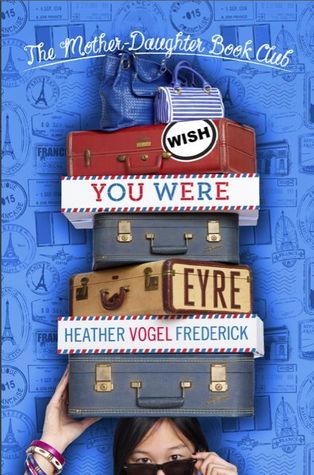
Book review: Wish You Were Eyre by Heather Vogel Frederick
The thirty-fifth book I read in 2018 was the sixth book in Heather Vogel Frederick's The Mother-Daughter Book Club series, Wish You Were Eyre. As indicated by the title, this time around the girls and their moms are reading Jane Eyre.
Megan's irrepressible Gigi brings home a French exchange student on the spur of the moment, and Megan is jealous of the newcomer's easy rapport with both her mother and her grandmother, not to mention all the boys at Alcott High. Worse (and in a truly unbelievable coincidence), Sophie is related to all the British characters in Pies and Prejudice, the dreamy brothers Berkeley and Emma's nemesis Annabelle.
In other areas, Emma and Stewart's relationship gets rocky again, Jess is accused of cheating and could lose her scholarship, Cassidy is skating at Nationals and might actually like boys but she's not sure which one, and Megan's mom runs for mayor of Concord. Oh, and Gigi has a whirlwind romance in Paris over spring break and comes home engaged.
Where to begin? First I have to admit that I enjoyed this book more than its predecessors. As the girls have gotten older, they've gotten more competent and less one-note (the smart one, the sporty one, the popular one -- they're like the Spice Girls).
Still, the contrivance is thick, and the connections to the classic novel seem weaker than usual. Jess's ordeal with an unfair teacher is meant to correspond to Jane at Lowood, Sophie Fairfax is standing in for Blanche Ingram, Emma's uncertainty about Stewart's feelings parallels Jane's experience with Mr. Rochester, Cassidy's triangle with Zach and Tristan is meant to parallel Jane's with St. John Rivers and Mr. Rochester, and Gigi, well, ... reader, she married him. Laid out like that, it seems clear, but reading the text as written, it's less obvious.
I was going to call shenanigans on Alcott High's spring break being in April rather than March, but looking up the Concord school calendar, they really do have spring break in April! I guess there's too much snow on the ground in March up north. In Oklahoma, Texas, and North Carolina where I've lived, spring break is always in March.
This book was Frederick's Reichenbach Falls; she intended it to be the last Mother-Daughter Book Club Book. Which is odd because it ends with the girls in 11th grade, when senior year would seem to be a more instinctual ending. More than that, she actually went out of her way to end the series at this point, since the girls read the whole Betsy-Tacy series in the fall of their junior year in Home for the Holidays and this book picked up right after New Year's where that one left off with them reading Jane Eyre in the spring.
I believe she compressed the last two books into one year on purpose, because two of the girls are dating seniors and going on to their own senior year would require her to take a side on Long-Distance Relationships: Yes or No. However, reading the series, as I am, in the author's future, I know that she got roped back in for one more book, Mother-Daughter Book Camp. It will be interesting to see what she does when forced past her intended expiration date.
You may notice that I left Becca out of the plot synopsis above. That's because her role in the story is so peripheral and so dumb that I left it out. But it does factor into the mad "problem play" matchmaking that goes on at the end of the book just to leave everyone paired off. Becca goes to Mankato for Spring Break with her grandmother, as planned in Home for the Holidays, and meets a boy named Theo Rochester who keeps snakes in his attic. Yes, really. Also, she's suddenly interested in architecture, apropos of a random comment made by her grandmother and nothing else every mentioned in this entire series so she plans to go the University of Minnesota where Theo Rochester will be going, based entirely on knowing him casually for less than a week. Also, she matches up Sophie with Third and Annabelle with Kevin Mullins, like the female protagonist of "The Pirate Movie."
Also, we're supposed to believe that the girls learned A Valuable Lesson about pranks when they nearly humiliate Sophie on national TV on Clementine's cooking show but fess up before it airs. However, Emma's book making fun of Annabelle and her friends and using those friends' actual nicknames is published, and that's a great thing, and no one will ever realize that when she says Stinkerbelle, Puff, Smiles, and Buttercup, she's actually referring to a group of girls she knows who are called Tinkerbell, Puff, Smiles and Buttercup. That is all.
Megan's irrepressible Gigi brings home a French exchange student on the spur of the moment, and Megan is jealous of the newcomer's easy rapport with both her mother and her grandmother, not to mention all the boys at Alcott High. Worse (and in a truly unbelievable coincidence), Sophie is related to all the British characters in Pies and Prejudice, the dreamy brothers Berkeley and Emma's nemesis Annabelle.
In other areas, Emma and Stewart's relationship gets rocky again, Jess is accused of cheating and could lose her scholarship, Cassidy is skating at Nationals and might actually like boys but she's not sure which one, and Megan's mom runs for mayor of Concord. Oh, and Gigi has a whirlwind romance in Paris over spring break and comes home engaged.
Where to begin? First I have to admit that I enjoyed this book more than its predecessors. As the girls have gotten older, they've gotten more competent and less one-note (the smart one, the sporty one, the popular one -- they're like the Spice Girls).
Still, the contrivance is thick, and the connections to the classic novel seem weaker than usual. Jess's ordeal with an unfair teacher is meant to correspond to Jane at Lowood, Sophie Fairfax is standing in for Blanche Ingram, Emma's uncertainty about Stewart's feelings parallels Jane's experience with Mr. Rochester, Cassidy's triangle with Zach and Tristan is meant to parallel Jane's with St. John Rivers and Mr. Rochester, and Gigi, well, ... reader, she married him. Laid out like that, it seems clear, but reading the text as written, it's less obvious.
I was going to call shenanigans on Alcott High's spring break being in April rather than March, but looking up the Concord school calendar, they really do have spring break in April! I guess there's too much snow on the ground in March up north. In Oklahoma, Texas, and North Carolina where I've lived, spring break is always in March.
This book was Frederick's Reichenbach Falls; she intended it to be the last Mother-Daughter Book Club Book. Which is odd because it ends with the girls in 11th grade, when senior year would seem to be a more instinctual ending. More than that, she actually went out of her way to end the series at this point, since the girls read the whole Betsy-Tacy series in the fall of their junior year in Home for the Holidays and this book picked up right after New Year's where that one left off with them reading Jane Eyre in the spring.
I believe she compressed the last two books into one year on purpose, because two of the girls are dating seniors and going on to their own senior year would require her to take a side on Long-Distance Relationships: Yes or No. However, reading the series, as I am, in the author's future, I know that she got roped back in for one more book, Mother-Daughter Book Camp. It will be interesting to see what she does when forced past her intended expiration date.
You may notice that I left Becca out of the plot synopsis above. That's because her role in the story is so peripheral and so dumb that I left it out. But it does factor into the mad "problem play" matchmaking that goes on at the end of the book just to leave everyone paired off. Becca goes to Mankato for Spring Break with her grandmother, as planned in Home for the Holidays, and meets a boy named Theo Rochester who keeps snakes in his attic. Yes, really. Also, she's suddenly interested in architecture, apropos of a random comment made by her grandmother and nothing else every mentioned in this entire series so she plans to go the University of Minnesota where Theo Rochester will be going, based entirely on knowing him casually for less than a week. Also, she matches up Sophie with Third and Annabelle with Kevin Mullins, like the female protagonist of "The Pirate Movie."
Also, we're supposed to believe that the girls learned A Valuable Lesson about pranks when they nearly humiliate Sophie on national TV on Clementine's cooking show but fess up before it airs. However, Emma's book making fun of Annabelle and her friends and using those friends' actual nicknames is published, and that's a great thing, and no one will ever realize that when she says Stinkerbelle, Puff, Smiles, and Buttercup, she's actually referring to a group of girls she knows who are called Tinkerbell, Puff, Smiles and Buttercup. That is all.
Subscribe to:
Posts (Atom)
Blog Archive
Labels
- Agatha Christie (3)
- Alexander McCall Smith (23)
- apologia pro sua vita (49)
- Art Linkletter (29)
- Austeniana (10)
- bibliography (248)
- birthday (21)
- Charles Lenox (3)
- Christmas (29)
- deep thoughts by Jack Handy (16)
- Grantchester Mysteries (4)
- Halloween (10)
- high horse (55)
- Holly Homemaker (19)
- Hornblower (3)
- Inspector Alan Grant (6)
- Isabel Dalhousie (8)
- life-changing magic! (5)
- Lord Peter Wimsey (6)
- Maisie Dobbs (9)
- Mark Forsyth (2)
- Mother-Daughter Book Club (9)
- No. 1 Ladies' Detective Agency (14)
- photo opportunity (103)
- pop goes the culture (73)
- rampant silliness (17)
- refrigerator door (11)
- Rosemary Sutcliff (9)
- something borrowed (73)
- the grandeur that was (11)
- where the time goes (70)