Thursday, June 30, 2016

Book review: Lieutenant Hornblower by C. S. Forester

The twenty-ninth book I read in 2016 was the second book in the Hornblower series by C. S. Forester, Lieutenant Hornblower.  In contrast to the first book in the series, which was a collection of shorter episodes, Lieutenant Hornblower is a true novel; also in contrast, rather than seeing things from Hornblower's perspective, the point-of-view character is Lieutenant Bush, a new arrival to the H.M.S. Renown, on which Hornblower is serving.  His narrative took me aback at first: Who is this Bush guy, and why are we spending so much time on him instead of Hornblower?  The note about the author at the end of the book, however, informed me that in the first Hornblower book written "introduced the now legendary characters Hornblower, Bush, and Lady Barbara," so clearly Bush is Maturin to Hornblower's Aubrey and will feature largely in the remainder of the series.  As such, I can imagine the excitement of reading about when Bush first met Hornblower in contemporary fans of the series, if I can't share it.

Hornblower and Bush are both junior lieutenants on an ill-fated voyage.  When the captain is incapacitated, it opens the door for less senior officers to direct the course of the ship and claim either glory and a chance at promotion or ignominy and disgrace.  Just when it seems everything's going to come up roses for Hornblower, a final ironic twist of fate intervenes, at least long enough for Hornblower to apply his native ingenuity and will to a very different problem.

Novel-length Hornblower is immensely satisfying, as is seeing Lieutenant Bush come around from his initial skepticism to full-blown Hornblower approval.  There is only a single nagging question left unanswered, despite being asked on multiple occasions.  Will the truth ever out?

Wednesday, June 29, 2016

Book review: The Titanic's Last Hero by Moody Adams

On the anniversary of the sinking of the Titanic, I read a post on a blog telling a story about that night which I had never heard before:

As the Titanic was sinking, Pastor [John] Harper was heard shouting, “Women, children, and unsaved into the lifeboats!” And as the Titanic began to break in two, many persons jumped into the icy water, including Pastor Harper. Before the hypothermia became fatal, Pastor Harper swam frantically to people pleading with them to believe in the Lord Jesus so that they could be saved in accordance with Acts 16:31. Pastor Harper swam to one young man and asked him, “Are you saved?” The young man replied that he was not. Pastor Harper tried to lead the young man to Jesus Christ, but the young man was near shock. Pastor Harper then took off his life preserver and threw it to the young man, saying, “Here then, you need this more than I do!” He then swam away to other people, but several minutes later, Reverend Harper returned to the young man and succeeded in leading him to Christ’s salvation. Of the more than 1,500 persons who went into the icy waters that tragic night, only six were rescued by the lifeboats. One of them was this young man, who was floating on debris. Four years later, at a Titanic survivors meeting, this young man stood up and in tears told how Pastor Harper had led him to Jesus Christ. He further told how Pastor Harper tried to help others, but because of the intense cold, he eventually grew too weak to swim. His last words before he sank beneath the waves were “Believe on the Name of the Lord Jesus, and you will be saved.”
Well, you know how reliable things can be that you read on the internet, so I decided to look into it. That led me to the twenty-eighth book I read in 2016, The Titanic's Last Hero by Moody Adams.

First off, calling it a "book" is a bit of a stretch.  It's more of a glorified pamphlet that was put together by John Harper's church as a memorial.  The first chapter, twelve pages, tells the story of what happened that night on the Titanic, and the second, thirteen pages, gives a biographical sketch of Harper's life before he got on the boat.  These are followed by several testimonials by people who knew Harper, a poem, and four surviving sermon outlines Harper prepared.

So is the story true?  We have only the word of the man who was rescued from the water, who told his story four years later and didn't leave his name to history.  I'd rather see a movie about John Harper than Jack and Rose, though.

Tuesday, June 28, 2016

Book review: Design for Murder by Carolyn G. Hart

As promised, the twenty-seventh book I read in 2016 was the second book in Carolyn G. Hart's Death on Demand series, Design for Murder.  Annie and her apparently ludicrously-profitable specialty bookstore are called upon by the cast of "Dallas" to run a Murder-Mystery Week for a Tour of Homes in a nearby town on the mainland.

All right, it's not actually the cast of "Dallas," but it's definitely the kind of stereotypical Southern community that go around stabbing each other in the back, sleeping with each other's spouses, and throwing drinks in each other's faces.  Fittingly, the murder mystery is an adaptation of "Who Shot J.R.?" in which everyone who knows the victim has a motive to want her dead.

So who does the provincial Southern police chief suspect?  Why, Annie Laurance, of course!  I hope Hart eventually finds a motive for Annie and Max to get involved in these investigations that's not clearing their own names; every police chief everywhere being a fat, corrupt, xenophobic Boss Hogg is already getting ridiculous after two outings.

Now that Annie is no longer coming up with reasons not to be involved with Max, she is less annoying, but Hart's contrivances still grate.  She clearly missed her calling as a writer for an interior design magazine, as she has never met a room she doesn't describe in fawning detail.  (Cream and rose must have been hot colors in 1987.)  When Annie finally gets to one of the Homes to be Toured, we get three paragraphs of English Sheraton cabinets, Meissen and Sevres china, French Empire card tables, and Chippendale mirrors before anyone gets any dialogue out.

More annoying is Hart's "I am eccentric, you are weird, he is crazy" attitude toward her characters. Early on, we see Max turning down a job he considers beneath him: digging up dirt on a property owner to blackmail him to sell his land to a developer at a bargain-basement price.  "Why don't you go after your money the old-fashioned way, Jenkins?"  he sneers.  "Why don't you earn it?"  Which, frankly, is rich, coming from a heir to a fortune who can't be bothered to take the South Carolina bar exam because it's just too much work.  But Max, Hart assures us, is a Good Rich Person, as opposed to everyone else on the island, who are Bad Rich People, though what evidence she has for that other than his inclination to spend his money at a whim on Annie rather than on some form of employment is never made clear.  And Annie herself falsifies the entries to her Murder Mystery game so that someone she knows can lay claim to part of the prize, an act that we're apparently supposed to think is kind rather than fraudulent.

Monday, June 27, 2016

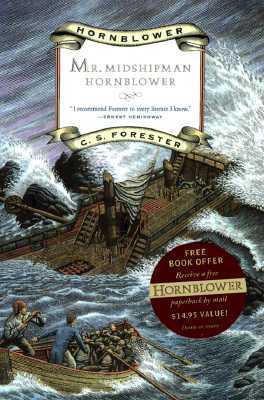
Book review: Mr. Midshipman Hornblower by C. S. Forester

After hearing good things about it for many years, Tommy and I finally started watching the Hornblower movies starring Ioan Gruffudd and shown on A&E around the turn of the millennium.  Having watched the first few disks, I decided to seek out the original books as well.  Thus, Mr. Midshipman Hornblower became the twenty-sixth book I read in 2016.

Although the first chronologically, Midshipman was the sixth of the Hornblower series C. S. Forester wrote, having begun in medias res with Hornblower in command of his own ship and then gone back to fill in the beginning of his naval career.  Hornblower's series is set during the Napoleonic Wars, thus making him a contemporary both of Jack Aubrey and of William Price, and contemplating the period through so many fictional characters is a delight.  Hornblower is written as more of a straightforward adventure story than the more soap-operatic focus of the Aubrey-Maturin series on its protagonists' personal lives, and nameless extras are killed off with gleeful abandon in the background where Jack Aubrey's crew is made up of more individuals whose demises strike closer to home.

Comparing the book to the beginning of the series of TV movies which are based on it, Hornblower comes off as a bit less of a moral paragon in the book than as portrayed by Gruffudd.  The greatest liberties were taken with "Hornblower, the Duchess, and the Devil," in which the part played by the titular Duchess was vastly expanded, no doubt because it's an embarrassment to a modern studio to have a series without a major female character.  For simplicity's sake, many of the same things happen to the same cast of characters in the TV version, which strains credulity a bit, whereas Forester has no problem introducing new characters in his stories.  (Of course, he didn't have to pay multiple actors, either.)

I quite enjoyed the book and am looking forward to the rest of the series.

Sunday, June 26, 2016

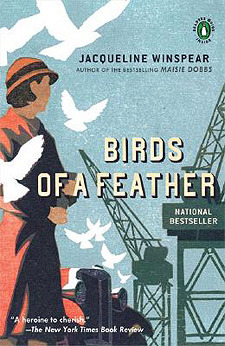
Book review: Birds of a Feather by Jacqueline Winspear

The twenty-fifth book I read in 2016 was the second book in Jacqueline Winspear's Maisie Dobbs series, Birds of a Feather.  I'm already wondering how far the author can go connecting mysteries to World War I; so far, all of Maisie's investigations have their origin point in the Great War.   In this book, a self-made man who rose from rags to riches in the grocery business hires Maisie to locate his heiress daughter, who has a history of running away from home.  What seems to be a frivolous case turns quickly foreboding when former friends of the missing woman start turning up murdered.

On the plus side, there's not another flashback to Maisie's salad days.  In the negative column, the whole "Maisie is psychic" angle gets played up even more.  Now her affinity to the spiritual realm is even cited as a reason Maurice took her on in the first place, when the extended flashback in the previous book didn't mention her gifts in that area until after she was already well advanced in her education.  And Billy is an opium fiend!  Only not really; he was accidentally overdosed when he was injured in the war and has suddenly started using again though no fault of his own: it was the war, you see....

I'm going to spoil the resolution a bit, so here's a bit of space if you don't care to be spoiled.

|

|

|

|

|

|

|

|

So the whole thing has to do with the white feather tradition and a bereaved family member blaming those who shamed young men into joining up by giving them a feather, implying cowardice, for not being in uniform.  But as Maisie herself admits, those who didn't enlist voluntarily would have been drafted eventually anyway.  We seem to be supposed to sympathize with the murderer (it was the war, you see...), but it's hard to figure why the villain/victim decides to kill so long after the deaths in question.  It's hardly sudden passion.

Saturday, June 25, 2016

Book review: The Comforts of a Muddy Saturday by Alexander McCall Smith

The twenty-fourth book I read in 2016 was the fifth of Alexander McCall Smith's Isabel Dalhousie novels, The Comforts of a Muddy Saturday.  Since I read book four, which I panned, I ran across a review of one of the books that suggested that McCall Smith intended for Isabel to come across as a modern Emma Woodhouse.  It's certainly a reasonable suggestion, since he has, in fact, written a modern Emma, which is on my to-read list, and while I'm not convinced it's an altogether successful gambit (largely because Isabel is older and should Know Better, while the original Emma has her youth and inexperience to excuse her unbearable tendencies), keeping it in the back of my mind did allow me to read this book without hating the protagonist as much as I have in previous forays.

In this installment, Isabel is enlisted to look into the mystery of a doctor whose career ended when he was accused of covering up inconvenient data in a drug trial.  If I say it amounts to as much as the mystery of Harriet Smith's parentage, you'll understand me.  She is also jealous of a new friend of Jamie's, loans Eddie money under false pretenses (or are they?  Really, who knows or cares?), and carries on an internal debate whether or not to be small and petty to the man she forced off the board of the magazine she bought last book.  All understandable acts of a spoiled teenager but less charming coming from a forty-year-old.

Friday, June 24, 2016

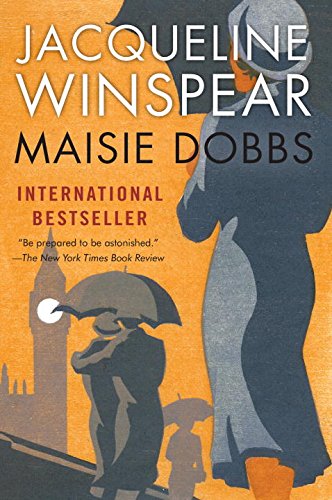
Book review: Maisie Dobbs by Jacqueline Winspear

"Superladies?  They're always trying to tell you their secret identity ... think it will strengthen the relationship or something like that.  I say, 'Girl, I don't wanna know about your mild-mannered alter ego or anything like that.  I mean, you tell me you're, uh, S-Super, Mega, Ultra Lightning Babe, that's all right with me.  I'm good.... I'm good.'" -- Frozone

"Sorry, blondie, I don't do backstory."  -- Flynn Rider

Because Tommy bought many of my Lord Peter Wimsey and Precious Ramotswe books as Christmas and birthday presents, Amazon tends to offer him similar books as recommendations.  One of these recommendations was Maisie Dobbs by Jacqueline Winspear.  He asked if I'd heard of it, I said no, and he decided to order it for me anyway.  So it became the twenty-third book I read in 2016.

Published in 2003, Maisie Dobbs is nonetheless set in London between the wars, just like the Peter Wimsey books.  We open with the titular heroine opening her office as a professional investigator.  In due time, she is hired for her first case, what seems like it may be a routine job following a wife whose husband suspects her of unfaithfulness.  Of course, since this is a detective novel, it turns out to be nothing so prosaic.  Maisie is competent and inventive, even if her primary schtick of discerning people's moods and emotions by aping their physical posture is a bit out there.  We are chugging along blithely for sixty-four pages when we run head on into a leviathan of a flashback.

Granted, the author has to know her protagonist's backstory.  But frankly, I was doing fine with it all being a bit vague: Maisie has an aristocratic benefactor and a European mentor; there's reference to a tragic love story as a nurse during the WWI years; she is currently romantically unattached and good at her job. But, no, Winspear has put a lot of thought into Maisie's past, and we're going to get it all, plopped down in the middle of the tracks like a landslide.

It's not terrible.  Enid is an arresting character, but she is truly the only part of Maisie's backstory that isn't predictable.  Pris, Iris, and Simon are straight out of BBC Central Casting.  But they're necessary for the big tear-jerking reveal at the end of the book, if not for the actual mystery they interrupt.  The thing is, I respect Maisie less for her by-the-book rags-to-riches story.  I can't help but think that Simon and Maisie's tragic romance would have been more affecting if it had been left more to the reader's imagination to fill in: less detailed -- and less stereotypical.  

Winspear was, at least, smart enough not to tell her story chronologically and open the book with Maisie-at-thirteen.  There's no way I would have made it through those 134 pages of 'Maisie grows up' if she hadn't already hooked me with Maisie grown-up.


Blog Archive