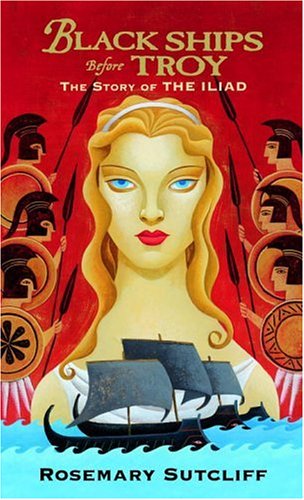
The sixth book I read in 2016 was Black Ships Before Troy: The Story of the Iliad by Rosemary Sutcliff. I picked it up in Half Price Books because I have enjoyed her Roman Britain books so much.
This is a very different book, however; rather than setting her own characters within a historic milieu, she sets out a straightforward retelling of the Greek epic from the original Homer. I never read the Iliad straight through; but we did the Odyssey in 9th grade English, and the Homerisms are evident, from grey-eyed Athene to the wine-dark sea, as well as the interminable funeral games, which are thankfully abbreviated in this telling.
One is struck by the Trojans' dumb tactics, as they have various allies arriving throughout the seige and, instead of waiting until they're all there and launching a coordinated assault on the Greeks, one set of allies arrives, attacks, and is wiped out before the next group of allies shows up. But the whole point of the Greek worldview is that mortals don't have any agency but serve as pawns of the gods, so I guess Troy was fated to fall anyway. Thus Virgil would have one believe, at any rate.
This would make a good classroom text for a middle school study of Classical history.
Wednesday, April 27, 2016
Tuesday, April 26, 2016
Book review: Misreading Scripture with Western Eyes by E. Randolph Richards & Brandon J. O'Brien
The fifth book I read in 2016 was Misreading Scripture with Western Eyes: Removing Cultural Blinders to Better Understand the Bible by E. Randolph Richards and Brandon J. O'Brien. Having already read Kenneth E. Bailey's books on reading the Bible through a lens informed by the culture of the Middle East, I expected this to be a similar work, written more for a layman's perspective, and I wasn't wrong.
This is certainly a simpler book, but it is also inferior to Bailey's works in more troubling ways. For one, Bailey makes it clear that the Middle Eastern culture is unique and that to understand the biblical accounts as they would have been understood by their original writers and readers, one must have an understanding of their worldview. Richards and O'Brien make a point in their introduction that human beings tend to be binary in their thinking -- Western/Eastern, good/bad, right/wrong -- but that reality often has more than two options; however, by choosing the "Western" worldview to denigrate, they absolutely do imply that the "Eastern" way is more biblical. The book could more accurately and less sensationally have been titled Misreading Scripture with American, Evangelical Eyes. I very strongly question the right of a couple of guys from a Baptist college in Florida to speak for Europe and North America as a whole, particularly when one of the blockbuster tidbits they drop is that Fanny is a girl's name in America but a rude, scatological term for female genitalia in England. Apparently, they've never heard of Fanny Burney, one of the most famous woman authors in England, or Fanny Price, heroine of the British Jane Austen's celebrated novel Mansfield Park. Such blatant ignorance does not predispose me to take their word on anything else they assert.
In addition, as opposed to Bailey's work, which is proffered in a spirit of humility and based on a lifetime of crosscultural immersion, there is a very strong sense of condescension toward American evangelicals in Misreading Scripture. Richards and O'Brien repeatedly assume that American Christians (despite the misleading title of their book, the focus is only and always on Americans, not Europeans) are jingoistic, xenophobic racists. "We won't even dare to consider the prejudice that some North American Christians might express [if a Korean missionary came to North America]." Really? Then don't consider it, and certainly don't put it in a snide endnote.
There is sadly more than a whiff of "I thank God I am not as other men, even these Americans" which pervades the whole book. I would certainly recommend that readers pick up Kenneth E. Bailey's Jesus Through Middle Eastern Eyes and Paul Through Mediterranean Eyes, despite their greater length and more intellectually demanding nature, before this book.
Sunday, March 6, 2016
Book review: Death on Demand by Carolyn G. Hart
For Christmas this year, my friend Leslie sent me the first volume of a long-running mystery series. Ironically, Carolyn G. Hart is from Oklahoma City and came to my high school for some sort of Career Day or Literature Day or something. I wasn't impressed with her. My admittedly vague memory is that she came across as arrogant and condescending, based on her great literary achievement as author (at that point) of a couple of airport novels.
So I went into the fourth book I read in 2016, Death on Demand, ready to dislike it. And there's a lot to dislike.
The protagonist, Annie Laurance, runs a bookstore on a touristy island, which is all but deserted when it's not summer. Sounds like a recipe for bankruptcy, no? It gets better. It's not even a general purpose bookstore; it only sells mysteries. And Annie is visibly, eye-rollingly annoyed with her best customer who special-orders books "by the carload" through her from the mainland. Get ready to go out of business when Amazon hits, Annie!
Annie has a sometimes-boyfriend named Max, whom she won't marry because he doesn't hold a steady job. He's the heir to a fortune, but she disapproves of people who don't work for a living ... or something. You can tell Max is rich because he has a "cellular phone in his Porsche." He uses his mother's maiden name because his actual last name is so recognizable that everyone would instantly boggle at him like the Midas he is. (Hart undoubtedly was thinking of something like Rockefeller, but I amused myself by imagining he's a Trump.)
Which leads us to the next annoying thing about Carolyn G. Hart. She's a namedropper. Mystery writers, yes, in discussion of Annie's store, most of whom I've never heard of, but more annoying, brand names. No one ever just drives a car; they drive a Honda or a Porsche. No one puts on suntan oil and lies on a towel; they slather on Hawaiian Tropic and spread out a Ralph Lauren towel. She's an eager little consumer-beaver, but the habit results in the most unintentionally hilarious line in the book, when Annie describes a woman whose mind is like "an IBM PCjr." What? I thought, It's a plastic brick with less computing power than a flip phone? I was fairly computer literate for the time in 1988, and I don't recall the IBM PCjr ever being the standard for the top of the line. Note to authors: "A mind like a steel trap" may be a cliché, but at least it doesn't badly date your manuscript.
The murder at the center of the plot is an overly-complicated Rube Goldberg device that would make Occam's razor weep. The murderer runs a string from a fuse box in the back room out into the main area of the bookstore, yanks it without anyone noticing to flip all the breakers and put out the lights, throws a single poison-tipped dart in the darkness, using the victim's lit cigarette as a target, opens a baggie containing a nail-polish-remover-soaked cotton ball and removes the clear nail polish from his or her fingertips that prevented any fingerprints from being left on the murder weapon, and throws away the baggie and cotton ball before the lights come back on.
I might mention that the cotton ball in the trash is discovered by the smell of acetone, but did anyone smell the acetone when the baggie was opened and the cotton ball was deployed? They did not. When the ploy is unraveled, does the police chief insist that everyone's hands be smelled to discover who was just swabbing the stuff all over themselves? He does not. Does anyone suggest that the tables, chairs, and coffee pot be dusted for prints to discover who didn't leave any? They do not. Is anyone detained or the scene secured for analysis ? Of course not. Stupid, stupid, stupid.
Naturally, the local police are Boss-Hogg levels of incompetent so Annie and Max have to investigate themselves. This involves all kinds of late-80s hilarity like racking up long-distance charges on one's Sprint card to research the suspects' backgrounds and having the results FedExed to them overnight. Ah, halcyon days before the Internet, when information wasn't instant and free. Another plot point revolves around a roll of film which must be taken to the mainland and developed ASAP. (Tourist-trap island doesn't have an overpriced One-Hour Photo? Okaaaay....)
I think the worst offense against reason, however, is a minor aside in one of these expensively-researched backgrounds, which requires one woman to have carried a pregnancy to term without her husband or anyone in her family being aware of it, while another woman's boyfriend believes that she got pregnant and had a baby without him ever noticing.
About halfway through this book, I was vehemently sure that if I managed to finish it, I'd never read anything by Carolyn G. Hart ever again. By the end, though, I was perversely intrigued. As a matter of fact, I've already picked up the second book of the series at the used-book store, hoping for more ludicrously-elaborate murders and hilariously-outdated technology.
There is one flaw I cannot forgive in a mystery writer, however, and Hart commits it. It is inconsistency. The reader depends on the author to provide reliable evidence; any inconsistencies the reader notices in the story ought to be clues that help unravel the mystery. However, on page 24, Annie's cat Agatha has green eyes, and on page 183, she has yellow eyes. In a mystery worth its salt, this ought to be a clue that it's not the same cat; unfortunately, Hart and her editors were just sloppy.
So I went into the fourth book I read in 2016, Death on Demand, ready to dislike it. And there's a lot to dislike.
The protagonist, Annie Laurance, runs a bookstore on a touristy island, which is all but deserted when it's not summer. Sounds like a recipe for bankruptcy, no? It gets better. It's not even a general purpose bookstore; it only sells mysteries. And Annie is visibly, eye-rollingly annoyed with her best customer who special-orders books "by the carload" through her from the mainland. Get ready to go out of business when Amazon hits, Annie!
Annie has a sometimes-boyfriend named Max, whom she won't marry because he doesn't hold a steady job. He's the heir to a fortune, but she disapproves of people who don't work for a living ... or something. You can tell Max is rich because he has a "cellular phone in his Porsche." He uses his mother's maiden name because his actual last name is so recognizable that everyone would instantly boggle at him like the Midas he is. (Hart undoubtedly was thinking of something like Rockefeller, but I amused myself by imagining he's a Trump.)
Which leads us to the next annoying thing about Carolyn G. Hart. She's a namedropper. Mystery writers, yes, in discussion of Annie's store, most of whom I've never heard of, but more annoying, brand names. No one ever just drives a car; they drive a Honda or a Porsche. No one puts on suntan oil and lies on a towel; they slather on Hawaiian Tropic and spread out a Ralph Lauren towel. She's an eager little consumer-beaver, but the habit results in the most unintentionally hilarious line in the book, when Annie describes a woman whose mind is like "an IBM PCjr." What? I thought, It's a plastic brick with less computing power than a flip phone? I was fairly computer literate for the time in 1988, and I don't recall the IBM PCjr ever being the standard for the top of the line. Note to authors: "A mind like a steel trap" may be a cliché, but at least it doesn't badly date your manuscript.
The murder at the center of the plot is an overly-complicated Rube Goldberg device that would make Occam's razor weep. The murderer runs a string from a fuse box in the back room out into the main area of the bookstore, yanks it without anyone noticing to flip all the breakers and put out the lights, throws a single poison-tipped dart in the darkness, using the victim's lit cigarette as a target, opens a baggie containing a nail-polish-remover-soaked cotton ball and removes the clear nail polish from his or her fingertips that prevented any fingerprints from being left on the murder weapon, and throws away the baggie and cotton ball before the lights come back on.
I might mention that the cotton ball in the trash is discovered by the smell of acetone, but did anyone smell the acetone when the baggie was opened and the cotton ball was deployed? They did not. When the ploy is unraveled, does the police chief insist that everyone's hands be smelled to discover who was just swabbing the stuff all over themselves? He does not. Does anyone suggest that the tables, chairs, and coffee pot be dusted for prints to discover who didn't leave any? They do not. Is anyone detained or the scene secured for analysis ? Of course not. Stupid, stupid, stupid.
Naturally, the local police are Boss-Hogg levels of incompetent so Annie and Max have to investigate themselves. This involves all kinds of late-80s hilarity like racking up long-distance charges on one's Sprint card to research the suspects' backgrounds and having the results FedExed to them overnight. Ah, halcyon days before the Internet, when information wasn't instant and free. Another plot point revolves around a roll of film which must be taken to the mainland and developed ASAP. (Tourist-trap island doesn't have an overpriced One-Hour Photo? Okaaaay....)
I think the worst offense against reason, however, is a minor aside in one of these expensively-researched backgrounds, which requires one woman to have carried a pregnancy to term without her husband or anyone in her family being aware of it, while another woman's boyfriend believes that she got pregnant and had a baby without him ever noticing.
About halfway through this book, I was vehemently sure that if I managed to finish it, I'd never read anything by Carolyn G. Hart ever again. By the end, though, I was perversely intrigued. As a matter of fact, I've already picked up the second book of the series at the used-book store, hoping for more ludicrously-elaborate murders and hilariously-outdated technology.
There is one flaw I cannot forgive in a mystery writer, however, and Hart commits it. It is inconsistency. The reader depends on the author to provide reliable evidence; any inconsistencies the reader notices in the story ought to be clues that help unravel the mystery. However, on page 24, Annie's cat Agatha has green eyes, and on page 183, she has yellow eyes. In a mystery worth its salt, this ought to be a clue that it's not the same cat; unfortunately, Hart and her editors were just sloppy.
Wednesday, February 3, 2016
Tuesday, February 2, 2016
Saturday, January 23, 2016
Book review: Not God's Type by Holly Ordway
The third book I read in 2016 was Not God's Type: An Atheist Academic Lays Down Her Arms by Holly Ordway. The author, an English professor at the time of her conversion, describes her journey to Christian faith through the witness of her fencing coach. It has striking similarities to Rosaria Champagne Butterfield's memoir, which is unsurprising due to their shared academic settings and waystations on the road to faith.
It is also reminiscent of Something Other Than God by Jennifer Fulwiler, a book I read in 2014 also published by Ignatius Press. If you know Ignatius Press, you'll not be surprised to note that both Fulwiler and Ordway end up professing Roman Catholics. (This is actually the second edition of Ordway's book; the first ended with her as a Protestant and was published by Moody Press.) I can't help but wonder why so many passionate and articulate converts end up in the Roman Catholic Church (my hypothesis: Ignatius Press is on it while evangelical publishing companies are busy publishing travelogues of heaven, reality TV tie-ins, and self-help books), but at least we have Butterfield and Susan Isaacs on this side of the Wittenburg Cathedral door.
Thursday, January 21, 2016
Book review: The Silver Branch by Rosemary Sutcliff
As with The Eagle of the Ninth, the book opens with a Roman soldier newly posted to Britain, but the setting is very different: instead of a Britain being steadily pacified under Rome, in this Britain, Rome is on the retreat from rebellious tribes in the north and under attack by Saxon raiders from the east. Back in Italy, the empire has already been split between two co-emperors, and Carausius, once a soldier in Rome's army himself, has declared himself emperor of Britain; due to rebellions and attacks from outlying tribes throughout Europe, the co-emperors have no choice but to accede to his claims for the time. It's a time period I know next to nothing about, as I don't recall ever learning any British history before William the Conqueror and the Roman history I had didn't go much beyond "All Gaul is divided into three parts" north of the Alps.
Justin is the junior surgeon sent to Britain, a place his family came from but he has never seen. At his posting, he meets his cousin Flavius, and we the readers come to understand that both are the descendents of Marcus and Cottia. Later on, the story takes the cousins back to the farm that Marcus promised Cottia at the end of The Eagle of the Ninth, as well as Uncle Aquila's house in Calleva; the eagle itself even makes an appearance, as does Marcus's father's emerald ring.
Despite the similar opening scenes, The Silver Branch evolves much differently from The Eagle of the Ninth, turning into a tense spy story, as the cousins work in an undercover resistance group, rescuing dissidents and waiting for the arrival of the Roman legions. Sutcliff introduces compelling secondary characters, from the upstart Carausius to the unlikely hero Paulinus to the stiff-upper-lip Aunt Honoria. I enjoyed this book at least as much as the first installment and look forward to reading more of Sutcliff's books.
Subscribe to:
Posts (Atom)
Blog Archive
Labels
- Agatha Christie (3)
- Alexander McCall Smith (23)
- apologia pro sua vita (49)
- Art Linkletter (29)
- Austeniana (10)
- bibliography (248)
- birthday (21)
- Charles Lenox (3)
- Christmas (29)
- deep thoughts by Jack Handy (16)
- Grantchester Mysteries (4)
- Halloween (10)
- high horse (55)
- Holly Homemaker (19)
- Hornblower (3)
- Inspector Alan Grant (6)
- Isabel Dalhousie (8)
- life-changing magic! (5)
- Lord Peter Wimsey (6)
- Maisie Dobbs (9)
- Mark Forsyth (2)
- Mother-Daughter Book Club (9)
- No. 1 Ladies' Detective Agency (14)
- photo opportunity (103)
- pop goes the culture (73)
- rampant silliness (17)
- refrigerator door (11)
- Rosemary Sutcliff (9)
- something borrowed (73)
- the grandeur that was (11)
- where the time goes (70)


