Sunday, November 8, 2015

Book review: The Nine Tailors by Dorothy L. Sayers

The thirty-seventh book I read in 2015 was The Nine Tailors by Dorothy L. Sayers.  It's not the last of the Lord Peter Wimsey novels, but it's the last one for me, as I read the Harriet Vane books first before going back to fill in the rest of the Wimsey oeuvre.  It actually has nothing to do with people who make or mend clothes for a living, although the misunderstanding does arise in the course of the story.

Lord Peter, traveling to Duke's Denver with the faithful Bunter, runs off the road after dark in the village of Fenchurch St. Paul and manages to get involved in a series of events surrounding a missing necklace which bankrupted an aristocratic family and an unidentified body interred in someone else's grave.  I'm not altogether convinced by the medical science which finally explains the death, but the circumstances are convincingly horrific and the fellow who suffered them suitably dastardly almost to deserve them.

Sayers's picture of parish life, and the care the parish priest provides to the souls in his neighborhood, is touching enough that even this devoted nonconformist got a little nostalgic.  One of the highlights of the book is a flood, to prepare for the arrival of which the whole village cranks into highly-efficient gear, under the direction of the rector, to turn the church into an emergency shelter.  The portrayal of pre-WWII stiff-upper-lipping and keeping-calm-and-carrying-on indicates all that was admirable about British character in the early twentieth-century.  The fact that Sayers apparently felt it morally necessary to punish the innocent victims of the villain's perfidy, in connection with the do-the-right-thing-and-kill-yourself-to-avoid-shame trope that appears in a couple of her books demonstrates the less-lamented aspects of the same period.

Monday, November 2, 2015

Reviewing a book review: In the Beginning Was the Word by Mark Noll

I quibble with Peter Thuesen's review of Mark Noll's book, In the Beginning Was the Word: The Bible in American Public Life, 1492-1783, in the November/December 2015 issue of Books & Culture.

Thuesen reports

...during the American Revolution, ... clergy of many stripes, along with secular pamphleteer Tom Paine, appealed to Scripture to justify the Patriot cause.  Ironically, the same Bible had been used earlier in the colonial era not to attack the British monarchy but to defend it as a bulwark against Catholic (especially French) tyranny.

Is it really ironic, though?  If a text is in favor of liberty (and any reading of the Pauline epistles can hardly help but come away with the impression that the New Testament is), can it not be profitably employed against a more authoritative regime in favor of a less, as well as against the less authoritative in favor of the democratic?  One can plausibly use medical research to argue that steak and mashed potatoes make a more healthy meal than a fast-food hamburger and fries, even if grilled fish and rice with steamed vegetables are more healthy than the steak and potatoes.

Later, Thuesen (and presumably Noll) bemoans that the freed slave and abolition activist Olaudah Equiano wrote an autobiography which, while rich with biblical allusions and quotation of Scripture, was "overwhelmingly a story of personal redemption.  As such, it typified the mostly apolitical uses of the Bible by other 18th-century evangelicals."  This is one of the rare instances I've seen of scholars criticizing people for failing to exploit Christianity for a political end.

Thuesen concludes that the book under review is "the most profound treatment ever written of the Bible in public life" [my bold].  While this may well be true -- I certainly haven't done the research to contradict it -- the extravagance of the claim gives one pause, particularly when the reviewer follows up by strawmanning, "All too often, histories of the Bible in America have uncritically glorified the American project, stopping just short of assuming that Moses and Jesus were Americans whose teachings were everywhere in harmony with the nation's imperial ambitions."  Such hyperbole demands citations to back it up, or it didn't happen.

Sunday, November 1, 2015

From today's Parade Magazine, where journalism goes to die

From this puff piece on Daniel Craig, promoting the new Bond film:

...film biographer David Thomson claims that Craig is the "least handsome" of the actors who've played the spy....  Thomson also says Craig is the most taciturn, "almost as if he had always wanted to be an actor instead of a star."
And yet from his very first outing in Casino Royale (2006), Craig has been a very believable Bond....
[My bolding]

Thomson's kiss-up to Craig (and snide implied put-down of the other Bonds) aside, it's "nice" to see the same bland incredulousness that was applied to Colleen McCullough in her obituary can smack men upside the head as well.  "Gosh, Daniel Craig's no George Clooney, and yet he's a good actor! It's almost as if a person's physical attractiveness has no relation to their value in other elements of life at all!"

Saturday, October 31, 2015

Halloween montage

 In 2012, Eric was Captain America, and Faith was Cleopatra.

Then, in 2013, Faith was Pikachu while Eric was, once again, Captain America.


In 2014, Faith was Pikachu again, and Eric was Emmet from The Lego Movie.

Thursday, October 22, 2015

Book review: The Dead Key by D. M. Pulley

The thirty-sixth book I read in 2015 was The Dead Key by D. M. Pulley.  Once a month, I'm offered a free e-book to download for my Kindle as an Amazon Prime member, and this was one of them for February.  Many months, none of the selections piques my interest, but for the low, low price of free, I was willing to give this one a try.

The book is set in the First Bank of Cleveland, both in 1978, when it's a bustling high-rise, and in 1998, when it's a derelict building, on the verge of renovation.  Our heroines are two, as well: Beatrice, a young secretary in 1978, and Iris, a recently-minted structural engineer drawing up a floor plan for the building's owners.  The two women are at either end of a mystery involving the sudden closure of the bank and the fate of unclaimed safety deposit boxes.

This was an exciting read.  There was one error in which one of the protagonists was called by the other one's name.  There were a couple of completely unnecessary sex scenes, which were doubly annoying due to the Hollywood/romance novel convention that the sexiness of an encounter is inversely proportional to the physical discomfort its location involves (desks, kitchen counters, stairs, etc.).  In this case, it was the bare tile floor of a bathroom.  The bathroom is directly off an office with normal furniture, presumably including some sort of couch, but, no, they go at it on the hard, cold tile floor. That can't be comfortable for either one of them.

The resolution of the mystery doesn't quite manage to measure up to my expectations, and I felt the author pulled her punches in exactly who ends up dead.  Still, it was an enjoyable read.  This is D. M. Pulley's first novel, and I'll certainly give an interested glance at her second.

Wednesday, October 21, 2015

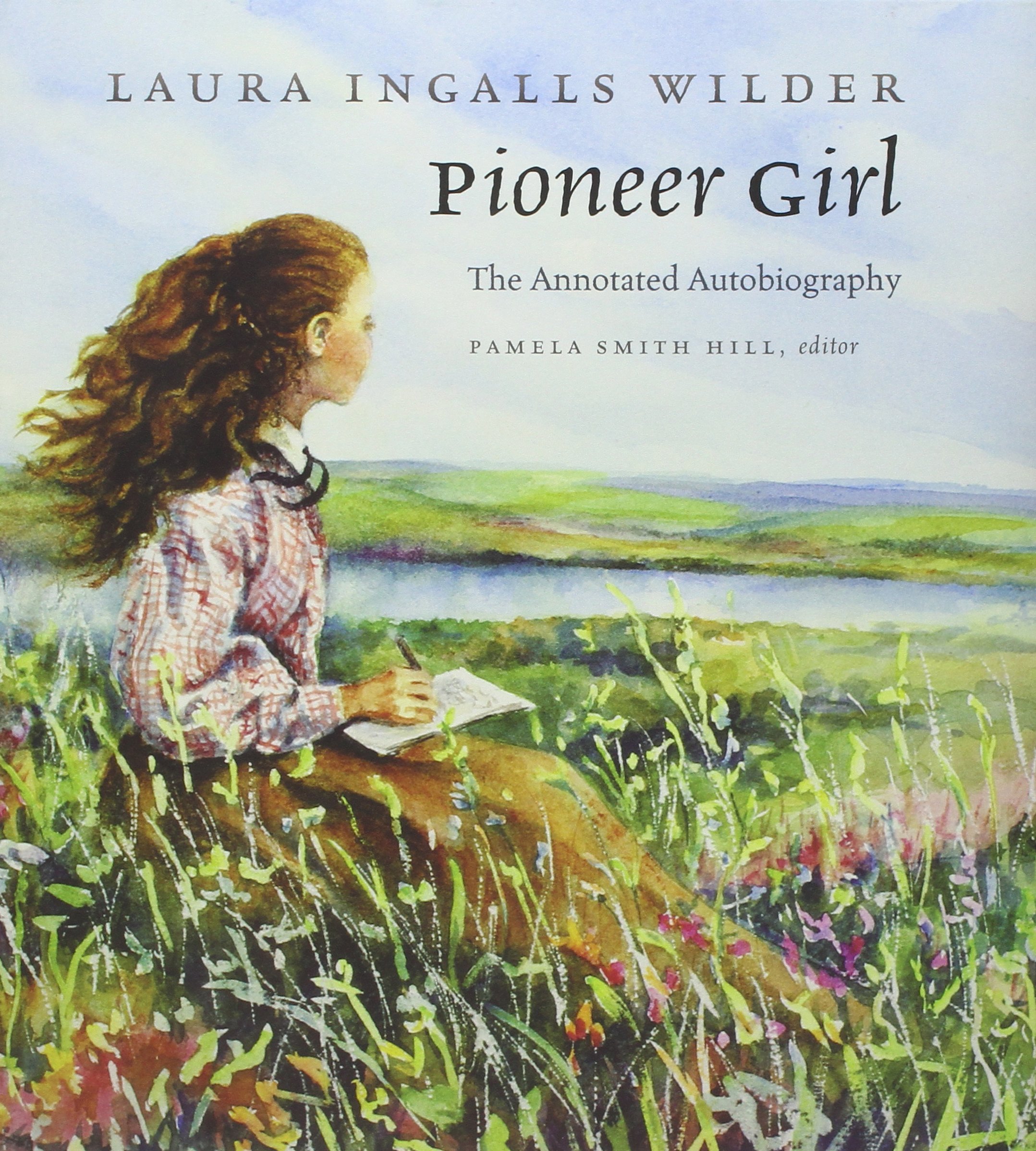
Book review: Pioneer Girl by Laura Ingalls Wilder

The thirty-fifth book I read in 2015 was Pioneer Girl: The Annotated Autobiography by Laura Ingalls Wilder.  This was Wilder's "first draft" of the Little House series.  The South Dakota Historical Society Press published it in December 2014 and immediately sold out of the first printing.  Did they really think they wouldn't?  Tommy ordered it for me at Christmas, but it ended up being a birthday present, as the order wasn't filled until March, when they finally started to catch up to demand.

If you've read the Little House books (and if you haven't, go read them first before turning to this), there will be very little to surprise you here, and if you've done any supplemental reading on Wilder's life, such as Donald Zochert's biography, there will be even less.  To me, the greatest value of this book is the revelation that Wilder's first draft was, in fact, so similar to the finished product, not the barely-literate oral history that Wilder's daughter, Rose Wilder Lane, transformed into a literary classic and patronizingly allowed her mother to take the credit for, as many literary historians have asserted. Their evidence for doing so seems to be outright bigotry: that a woman who lived virtually her whole life as a housewife on a farm couldn't possibly have produced a work of such talent or lasting influence.  Much more likely that it was the extensively-traveled, feminist, divorced daughter, though it's puzzling why she never broke out any of that literary genius on a book published under her own name.

Saturday, September 5, 2015

J. I. Packer on cynicism

"Feeling disillusioned, discouraged, and hurt by their experience of life, their pained pride forbids them to think that others might be wiser and doing better than they themselves have done.  On the contrary, they see themselves as brave realists and everyone else as self-deceived."

-- J. I. Packer, "The Joy of Ecclesiastes," Christianity Today, Sept. 2015, 58.

Blog Archive