Thursday, December 31, 2015

Book review: Unequal Affections by Lara S. Ormiston

It is a truth universally acknowledged that the most common category of Jane Austen fiction is the sequel: Elinor and Marianne are married off so let's get to Margaret, or Mr. and Mrs. Darcy solve murders in the English countryside in the manner of Nick and Nora.  Another category which seems to be growing, however, is the "counterfactual" retelling of the original novels, diverging at a certain point in the narrative and imagining how events might have ensued if the characters made different choices.

The sixty-second book I read in 2015 is just such a novel: Unequal Affections: A Pride & Prejudice Retelling by Lara S. Ormiston.  The author posits that Lizzy accepts Darcy's first proposal in Kent rather than telling him off and imagines how their engagement might follow.

For about the first half of this book, I expected that it might join Pamela Aidan's Darcy trilogy at the top of my list of Austeniana.  The writing and characterization are largely consistent with the original (though surely it should be "Miss Bennet and Miss Elizabeth Bennet" when Jane and Lizzy pay a call, not "Miss Bennet and Miss Bennet"), and the story it tells, of a woman who accepts a proposal of marriage based on the advantages of the man making the offer and her doubt that she'll receive a better rather than overwhelming love, is both undertold and undoubtedly more common to the era than the marriages of true minds that Austen chronicles.

As the engagement drags on, however, Ormiston falls into the fan-fiction trap of letting the characters talk too much.  Jane Austen can be infuriating about not reporting exactly what is said between Emma and Mr. Knightley, but leaving the reader wanting more is better than having them wish Darcy and Elizabeth would just shut up about how wonderful the other partner is.  Ormiston's Darcy requests a short engagement of only a month, but when the betrothed pair spend the entire time talking to or about one another, it's too long for my tastes.  Elope, already.

Lydia's honor is saved in this retelling, despite her best efforts, but we are deprived of Elizabeth's visit to Pemberley.  She won't see it in Ormiston's world until after her marriage.

Wednesday, December 30, 2015

Book review: The Daughter of Time by Josephine Tey

Josephine Tey opens the fifth book in her Inspector Alan Grant series with a swipe at series of novels: "Authors today wrote so much to a pattern that their public expected it.  ...  Their interest was not in the book but in its newness.  They knew quite well what the book would be like."  With such a knowing remark as that one, it should come as no surprise that Tey consciously breaks the expected pattern in The Daughter of Time, the sixty-first book I read in 2015.

Alan is laid up in hospital for the entirety of the novel, recovering from a broken leg suffered while chasing down a suspect.  Bored beyond words by the books sent to him by friends to pass the time (hence the remarks about formulas), he is encouraged by Marta Hallard to explore the coldest of cold cases: historic unsolved mysteries.  Inspired by this contemporary portrait by an unknown artist and aided by a young American scholar, he takes up the rehabilitation of Richard III, whom Shakespeare indelibly marked as a villain.

Richard III is clearly a hobbyhorse of Tey's, and while her arguments that he wasn't the murderer the history written by his enemies portrayed him to be are persuasive, I find Alan's reasoning specious. Tey once again relies on the proposal that a person can be reliably judged by his demeanor, and since Inspector Grant, with his canny sense of people, thinks Richard looks honest, he can't possibly be a devious plotter and premeditated murderer.  Add to this that Alan is basing his judgment on a portrait, rather than a photograph or first-hand sight of the man in question, and that, moreover, he questions the talent and ability of the unknown painter competently to portray the king, and his basis for taking up the investigation in the first place is unsound, no matter how logical the rest of his deductions may be.

Tuesday, December 29, 2015

Book review: The Shining Company by Rosemary Sutcliff

The sixtieth book I read in 2015 was The Shining Company by Rosemary Sutcliff.  While not part of the Roman Britain trilogy which The Eagle of the Ninth opened, it is a historical novel set on the same island some centuries later, and it's interesting to see how the place names have changed from the map in that book to this one.

Like The Eagle of the Ninth, this book opens with a set of three characters: two boys, one the slave of the other, and a girl.  For a while I was afraid that the character development would parallel that of the earlier book -- that she has a "formula" -- but the triangle in The Shining Company heads in different directions than Marcus, Esca, and Cottia.

Prosper, the younger son of a chieftan, lives in the absence left behind by the Roman Legions, his closest companions his bondservant Conn and his kinswoman Luned.  His childhood is irreversibly marked by two encounters; one with a traveling merchant, Phanes of Syracuse, and his tales of the emperor's court in Constantinople, and the second with Prince Gorthyn who comes to his father's lands to hunt a rare white hart and inspires a lifelong loyalty.  When Prosper comes of age, Gorthyn remembers the boy's impulsive request to ride at his side and takes him as shieldbearer when the great king Mynyddog calls for warriors to repel the Saxons.  Based on the medieval Welsh poem, Y Goddodin, the remainder of the novel imagines the preparation for and carrying out of the Gododdin's attack on Catraeth.

While I didn't enjoy it as much as The Eagle of the Ninth, The Shining Company was an interesting and affecting read and shines some (speculative) light on a period of history about which I know very little.


Monday, December 28, 2015

Book review: To Love and Be Wise by Josephine Tey

The fifty-ninth book I read in 2015 was To Love and Be Wise, the fourth Alan Grant novel by Josephine Tey.  Inspector Grant is picking up recurring will-they-or-won't-they character Marta Hallard for a not-a-date when he happens to meet an arresting American photographer, whose sudden arrival in London upsets the lives and loves of the artsy crowd Tey loves to chronicle.  The upheaval is only exacerbated by the sudden mysterious disappearance of the American, under circumstances that throw suspicion in all directions.

Actress Marta Hallard really comes into her own in this book, having been a recurring character from the beginning of the series.  For the first time, one truly hopes that she and Alan might get unPlatonic.

Tey's grasp of American geography is a bit suspect.  For one thing, she seems to think it entirely reasonable that a photographer of Hollywood stars would live in San Francisco, as if there weren't 400 miles separating it from Los Angeles; for another, she refers to Peoria and "Paduca" (rather than Paducah, Kentucky), at least in my paperback edition.

Sunday, December 27, 2015

Book review: The Franchise Affair by Josephine Tey

The fifty-eighth book I read in 2015 was The Franchise Affair by Josephine Tey.  It is, technically, an Inspector Alan Grant novel, in the sense that Grant appears in the book, but he plays a very small part and is, in this case, the enemy.  The sleuth we're following in this book is a small-town solicitor, Robert Blair, pulled into "the Franchise affair" quite against his will.

The Franchise is a house outside of the village, the home of a single woman and her mother who inherited the property a few years earlier.  By the standards of the village, this still makes them newcomers and outsiders, so when the pair are accused of a serious crime, the locals are all too eager to believe ill of them.

With all the resources of Scotland Yard and Inspector Alan Grant arrayed against him, Robert Blair rallies to cast off quotidien affairs, call in favors, and discover resources he never knew he possessed to prove Mrs. and Miss Sharpe innocent.

The book is relentlessly relevant to today's media cycle, with the damage that a mere accusation can wreak painted in vivid detail.  Tey is merciless against do-gooders with various progressive "causes." Unfortunately, there is also a very ugly eugenicist streak on display in her writing, particularly the revelation that the accuser is adopted and the natural daughter not of a respectable middle-class woman (in which case her veracity could not be questioned) but of an unfaithful lower-class wife (in which case she could clearly be nothing but a criminal and liar).

While truth eventually triumphs, Tey is unsentimental about the power of legal vindication to eradicate the effects of prejudice.  (As Mark Twain is rumored to have said, "A lie can travel halfway around the world before the truth can get its boots on," and the fact that Twain almost assuredly didn't say it but is still credited with the quotation only proves the point.)  The ending is hopeful, if not traditionally happily-ever-after, and everyone involved with the Franchise affair becomes a better person due to their involvement.


Friday, December 18, 2015

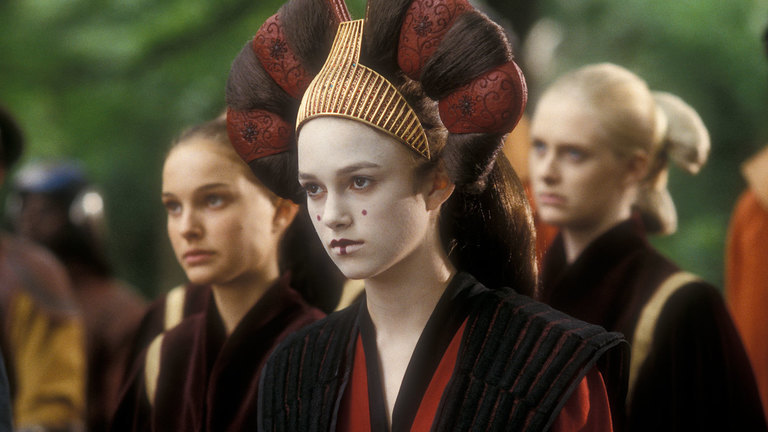
"But they're cousins! Identical cousins, all the way!"

So, yeah, there's this little movie that just opened called "The Force Awakens": you may have heard of it.

No, I haven't seen it yet.  We sat on the sidewalk for hours to see an opening Saturday showing the "The Phantom Menace" back in the day, and that convinced me that seeing a Star Wars movie on opening weekend isn't worth the hassle.  We will see it, but it might not be until after Christmas.

Anyway, obviously, everyone everywhere is doing some sort of Star Wars branding, which led to me reading this analysis of the success or lack thereof of the post-Star Wars careers of the actors involved, which led to me only just now realizing that the fake Amidala/lookalike handmaiden from "Phantom Menace" was played by Kiera Knightley.  All these years, I thought Natalie Portman was doing a Patty Duke/Samantha Stevens lookalike cousin thing with a split screen.


So what lesson can be drawn from this?  Heavily made-up women are interchangeable à la Robert Palmer videos?  Keira Knightley and Natalie Portman ought to play twins?  "The Phantom Menace" explained way too much about midichlorians and trade agreements and used too much CGI and didn't spend enough time on the main characters?  All of the above?

Friday, December 4, 2015

OMG OMG OMG you guys!


Took Eric to Target yesterday for him to pick out a Christmas gift for Faith, and I saw this on the end cap.  He heard my audible gasp of delight as I picked it up and asked what the deal was.

"I loved this doll when I was a little girl!  I had all of them!*  And it's exactly like the one I got when I was seven!"

"Ah," he answered wisely, "childhood memories.  You should buy it!  It will make you happy."

I bought it.  I am happy.

*Technically untrue.  I never got Plum Pudding, which rankled for a while.

Blog Archive